February 19, 2026



AI shopping assistants have fundamentally changed how consumers discover and evaluate products. When users ask ChatGPT for product recommendations or Google AI Overviews for buying advice, they receive curated suggestions—not a list of ten blue links to click through.
For e-commerce brands, this shift demands specific optimization beyond general AI search optimization tactics. Product visibility in AI shopping search requires structured data, optimized product content, and measurable attribution systems that most e-commerce sites haven't implemented.
This guide provides the specific AEO tactics e-commerce brands need to appear when AI assistants answer shopping queries.
AI shopping behavior differs fundamentally from traditional search:
Traditional e-commerce search:
AI shopping search:
The compression of the shopping journey from hours to minutes changes everything about e-commerce optimization.
ChatGPT's shopping capabilities have expanded significantly. Users now ask directly:
ChatGPT responds with specific product recommendations, often with pricing, where to buy, and key differentiators. Products that appear in these recommendations capture high-intent buyers at the decision moment. Understanding how to rank on ChatGPT has become essential for e-commerce visibility.
Google AI Overviews now appear for approximately 47% of product-related queries, according to industry tracking data. These overviews synthesize buying advice from multiple sources, often recommending specific products or directing users to particular retailers. Implementing Google AI Overviews optimization strategies ensures your products appear in these high-visibility positions.
Product query types triggering AI Overviews:
E-commerce sites that appear in these AI Overviews capture traffic before traditional organic results.
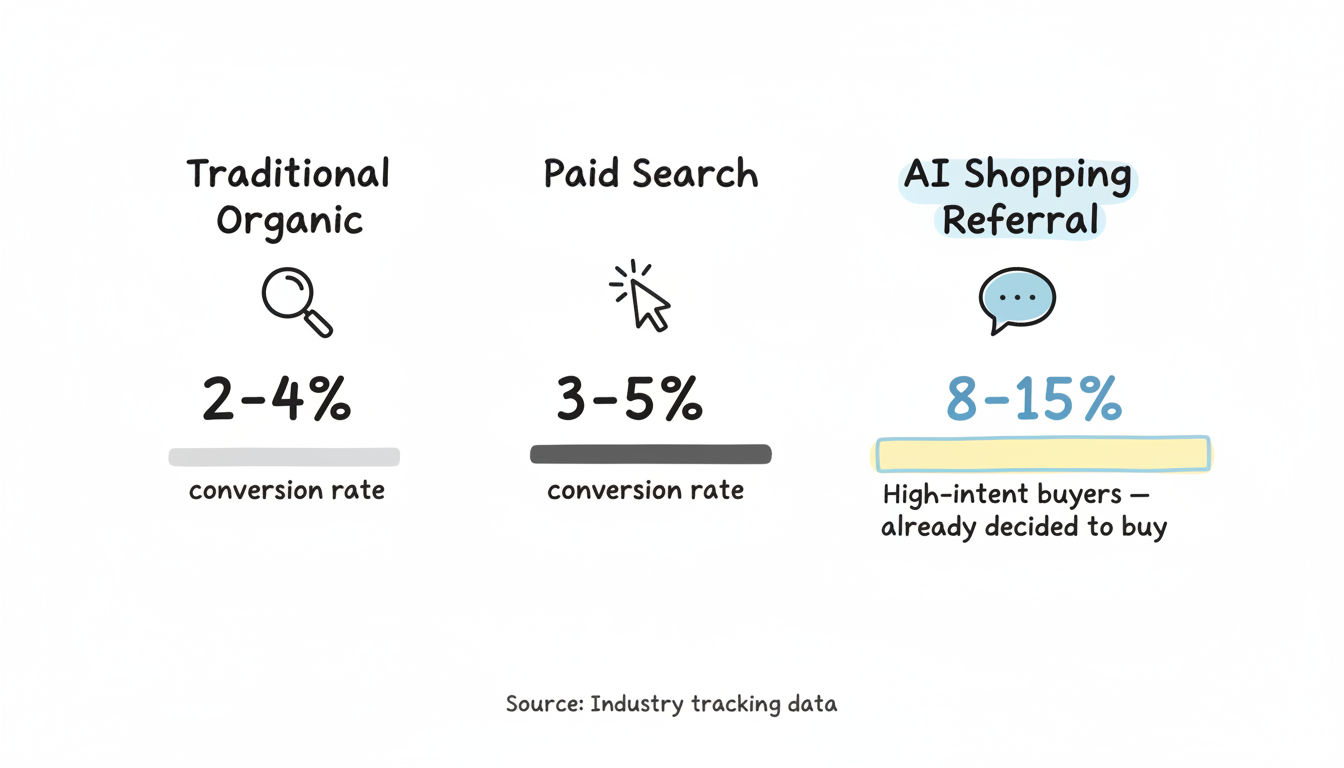
AI-referred e-commerce traffic converts at dramatically higher rates than traditional organic:
Traffic Source | Typical E-commerce Conversion Rate |
Traditional organic | 2-4% |
Paid search | 3-5% |
AI shopping referral | 8-15% |
The conversion advantage stems from intent qualification—users asking AI for product recommendations have already decided to buy. They want help choosing, not researching whether to purchase. Proper AI search traffic attribution helps quantify this value.
Structured data forms the foundation of e-commerce AEO. AI systems rely heavily on schema markup to understand product attributes, pricing, and availability.
Core Product schema implementation:
{
  "@context": "https://schema.org/",
  "@type": "Product",
  "name": "Brooks Ghost 15 Running Shoes",
  "description": "Neutral road running shoe with DNA LOFT cushioning for everyday training",
  "brand": {
    "@type": "Brand",
    "name": "Brooks"
  },
  "sku": "GHOST15-001",
  "gtin13": "0190340890123",
  "category": "Running Shoes > Neutral > Road",
  "image": [
    "https://example.com/images/ghost-15-main.jpg",
    "https://example.com/images/ghost-15-side.jpg"
  ],
  "offers": {
    "@type": "Offer",
    "url": "https://example.com/brooks-ghost-15",
    "priceCurrency": "USD",
    "price": "139.95",
    "priceValidUntil": "2026-12-31",
    "availability": "https://schema.org/InStock",
    "itemCondition": "https://schema.org/NewCondition",
    "seller": {
      "@type": "Organization",
      "name": "Your Store Name"
    }
  }
}
AI shopping assistants prioritize products with clear, current pricing. Missing or stale price data disqualifies products from recommendations.
Pricing schema best practices:
Availability schema addition:
"shippingDetails": {
  "@type": "OfferShippingDetails",
  "shippingDestination": {
    "@type": "DefinedRegion",
    "addressCountry": "US"
  },
  "deliveryTime": {
    "@type": "ShippingDeliveryTime",
    "handlingTime": {
      "@type": "QuantitativeValue",
      "minValue": 0,
      "maxValue": 1,
      "unitCode": "d"
    },
    "transitTime": {
      "@type": "QuantitativeValue",
      "minValue": 2,
      "maxValue": 5,
      "unitCode": "d"
    }
  },
  "shippingRate": {
    "@type": "MonetaryAmount",
    "value": "0",
    "currency": "USD"
  }
}
Product reviews directly influence AI recommendations. Well-structured review data helps AI systems evaluate product quality and match products to specific use cases.
AggregateRating schema:
"aggregateRating": {
  "@type": "AggregateRating",
  "ratingValue": "4.6",
  "reviewCount": "2847",
  "bestRating": "5",
  "worstRating": "1"
}
Individual Review schema (include 2-3 per product):
"review": [
  {
    "@type": "Review",
    "reviewRating": {
      "@type": "Rating",
      "ratingValue": "5",
      "bestRating": "5"
    },
    "author": {
      "@type": "Person",
      "name": "Verified Buyer"
    },
    "reviewBody": "Perfect for my flat feet. Great arch support and cushioning for daily 5K runs.",
    "datePublished": "2026-01-05"
  }
]
Beyond schema, product description content determines whether AI systems understand your product well enough to recommend it.
AI systems extract key features from bullet points. Optimize bullets for extractability using AI search ranking factors principles:
Weak product bullets (hard for AI to extract):
Strong product bullets (AI-extractable):
Each bullet contains specific, factual information AI can cite when explaining why a product suits a particular need.
Technical specifications presented in structured tables help AI compare products. Consider list formatting for LLM optimization when structuring product data:
Specification | Value |
Weight | 9.8 oz (men's), 8.2 oz (women's) |
Heel Drop | 12mm |
Cushioning | DNA LOFT |
Support Type | Neutral |
Surface | Road |
Best For | Daily training, long runs |
Tables with consistent formatting enable AI systems to make accurate comparisons across products.
AI shopping assistants match products to specific user needs. Content must explicitly state who the product serves:
Vague use case (AI struggles to match): "Great all-around shoe for runners of all levels."
Clear use case (AI can match): "Designed for neutral runners logging 20-40 miles per week. The Ghost 15 excels at daily training runs between 3-10 miles. Runners with high arches or neutral pronation get optimal support. Not recommended for trail running or runners needing stability features."
Clear use case statements help AI recommend your product to the right queries while avoiding mismatched recommendations that lead to returns.
Category pages often capture broader shopping queries like "best running shoes 2026" or "running shoes for beginners." Optimizing these pages requires understanding landing page optimization for AI search.
Category pages with integrated buying guides perform better in AI shopping search:
Effective category page structure:
## How to Choose Running Shoes
[Buying criteria explanation]

## Best Running Shoes by Category
### Best for Daily Training: [Product]
### Best for Long Distance: [Product]
### Best for Beginners: [Product]

## Product Grid
[Full category listings]
This structure provides AI with recommendation-ready content while maintaining e-commerce functionality.
AI shopping assistants frequently need to compare products. Category pages with comparison content get cited more often:
Comparison table format:
Feature | Product A | Product B | Product C |
Price | $139.95 | $149.95 | $119.95 |
Weight | 9.8 oz | 10.2 oz | 9.4 oz |
Cushioning | DNA LOFT | React Foam | Fresh Foam |
Best For | Daily training | Marathon | Budget runs |
AI systems extract comparison tables directly when answering "Product A vs Product B" queries.
Product filters should reflect how users ask AI for recommendations:
Traditional filter attributes:
AI-optimized filter attributes:
When your filter categories match how users phrase AI queries, your category pages become more likely citation sources.
User-generated content provides signals AI systems use to evaluate products. Implementing QAPage schema for AI content enhances this further.
Beyond AggregateRating schema, implement detailed review markup:
Best practices for review optimization:
Product Q&A sections provide extractable content for AI systems:
Q&A format example:
Q: Are these good for people with plantar fasciitis? A: Many customers with plantar fasciitis report relief with the Ghost 15's DNA LOFT cushioning. However, severe cases may benefit from the Adrenaline GTS with additional stability features.
Q&A content directly answers questions users ask AI assistants, making your product pages citation targets.
AI systems evaluate social proof when making recommendations:
Extractable social proof elements:
Prominently displayed social proof gets extracted into AI recommendations.
E-commerce AEO requires specific measurement beyond general AI visibility tracking. Use AEO checker tools to monitor performance systematically.
Monitor which products appear in AI shopping recommendations:
Product-level tracking protocol:
Segment AI shopping traffic for conversion analysis using AEO analytics setup methods:
Referral source identification:
Metrics to compare:
Metric | Traditional Organic | AI Shopping Referral |
Conversion rate | Track baseline | Compare to baseline |
Average order value | Track baseline | Often higher |
Return rate | Track baseline | Usually lower |
Time to purchase | Track baseline | Typically faster |
Connect AI visibility to revenue:
Attribution model for AI shopping:
AI Recommendation → Product Page Visit → Purchase → Revenue
         ↓
   Track and attribute
Even imprecise attribution helps justify AEO investment. If AI referrals convert at 12% versus 3% for organic, the value proposition becomes clear.
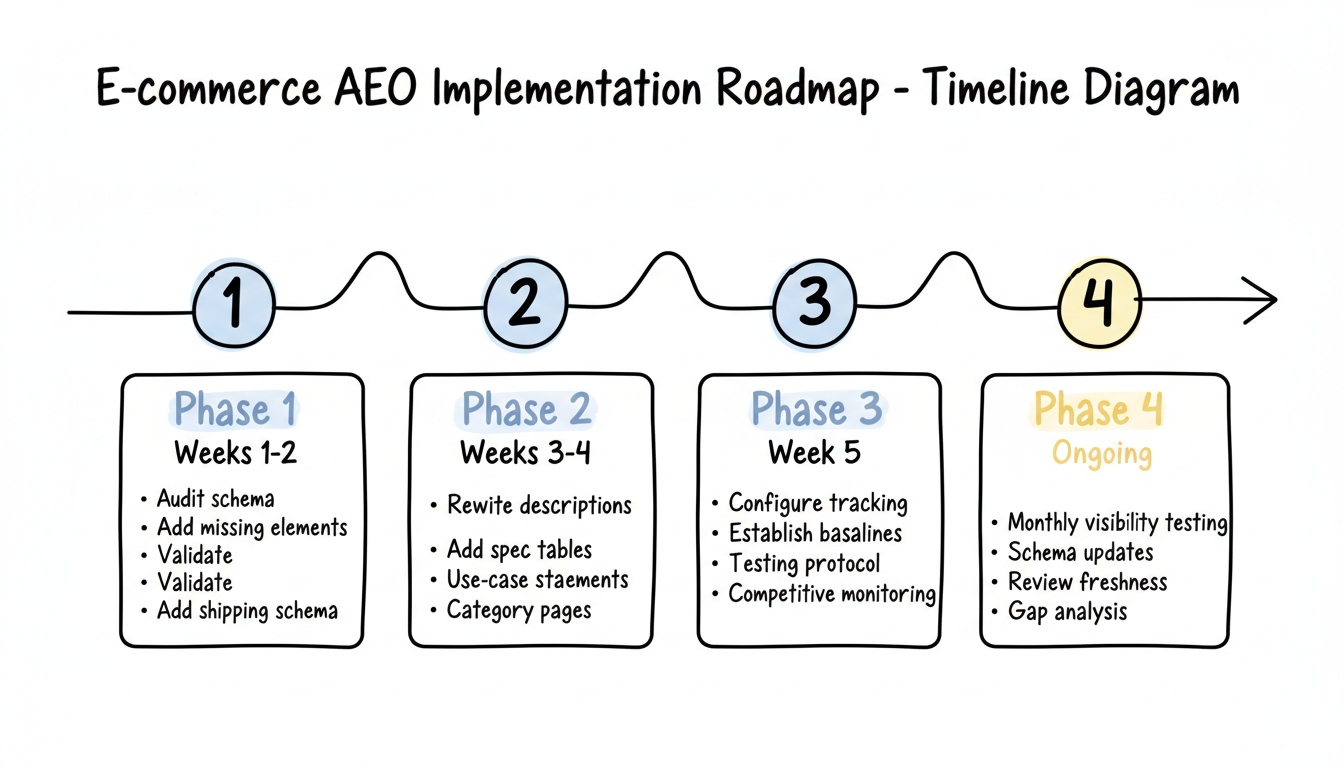
E-commerce AEO requires specific optimizations beyond general AI visibility tactics:
The brands that optimize for AI shopping search now will capture the high-intent, high-converting traffic that increasingly bypasses traditional search results. Leveraging AI search optimization tools and following ChatGPT SEO optimization guide principles will accelerate your progress in this emerging channel.
By submitting this form, you agree to our Privacy Policy and Terms & Conditions.