February 19, 2026


Amazon PPC advertising has become essential for sellers looking to compete on the world's largest e-commerce platform. With over 70% of Amazon sellers now using Amazon Ads and competition intensifying every year, working with a specialized Amazon PPC agency can mean the difference between profitable growth and wasted ad spend.
This guide covers everything you need to know about Amazon PPC agency services—from what agencies actually do and how much they cost to key metrics like ACoS and TACoS that determine campaign success.
Organic visibility on Amazon is increasingly difficult to achieve. The algorithm favors products with strong sales velocity, which creates a chicken-and-egg problem: you need sales to rank, but you need visibility to get sales. Amazon PPC bridges this gap.
Key reasons Amazon PPC is essential:
According to industry data, Amazon advertising revenue exceeded $50 billion in 2025, reflecting how central PPC has become to seller success. Sellers who don't advertise are essentially invisible on many competitive search terms, much like businesses that lack a comprehensive PPC advertising strategy across other platforms.
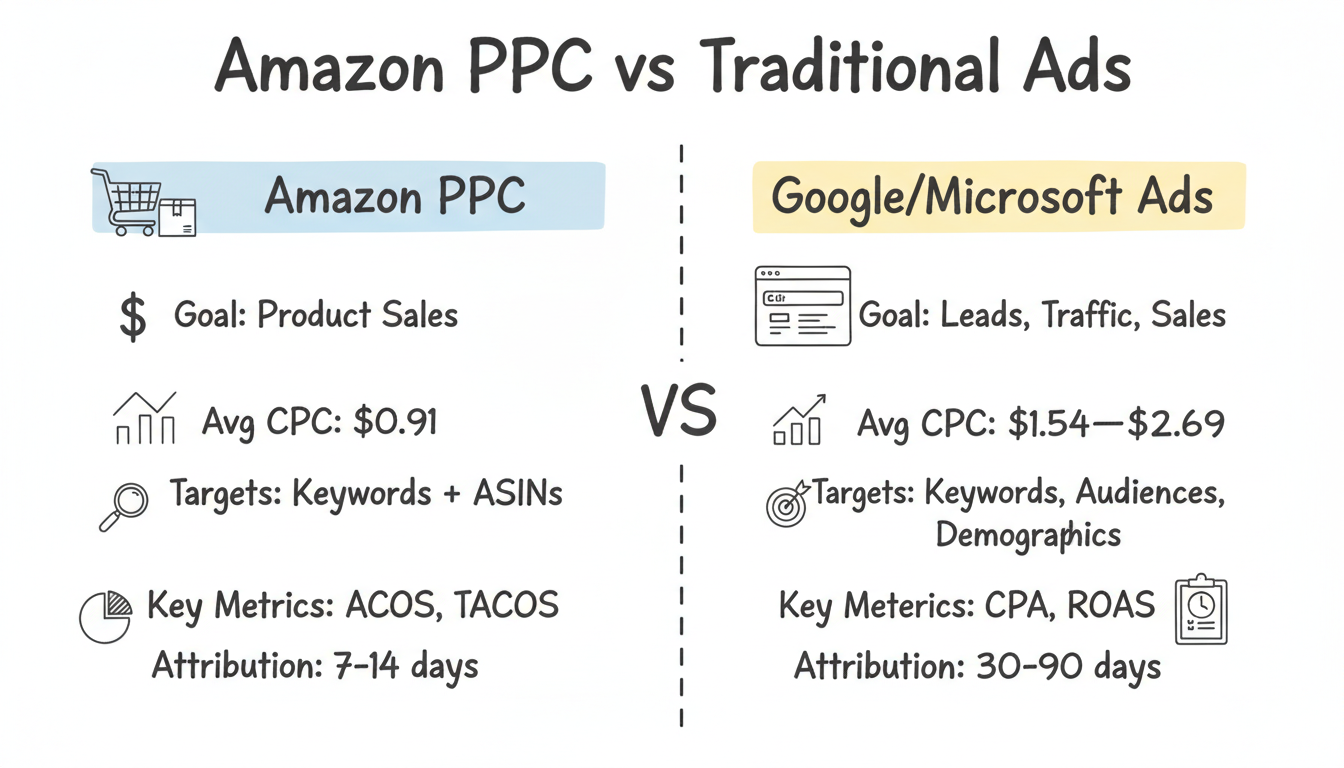
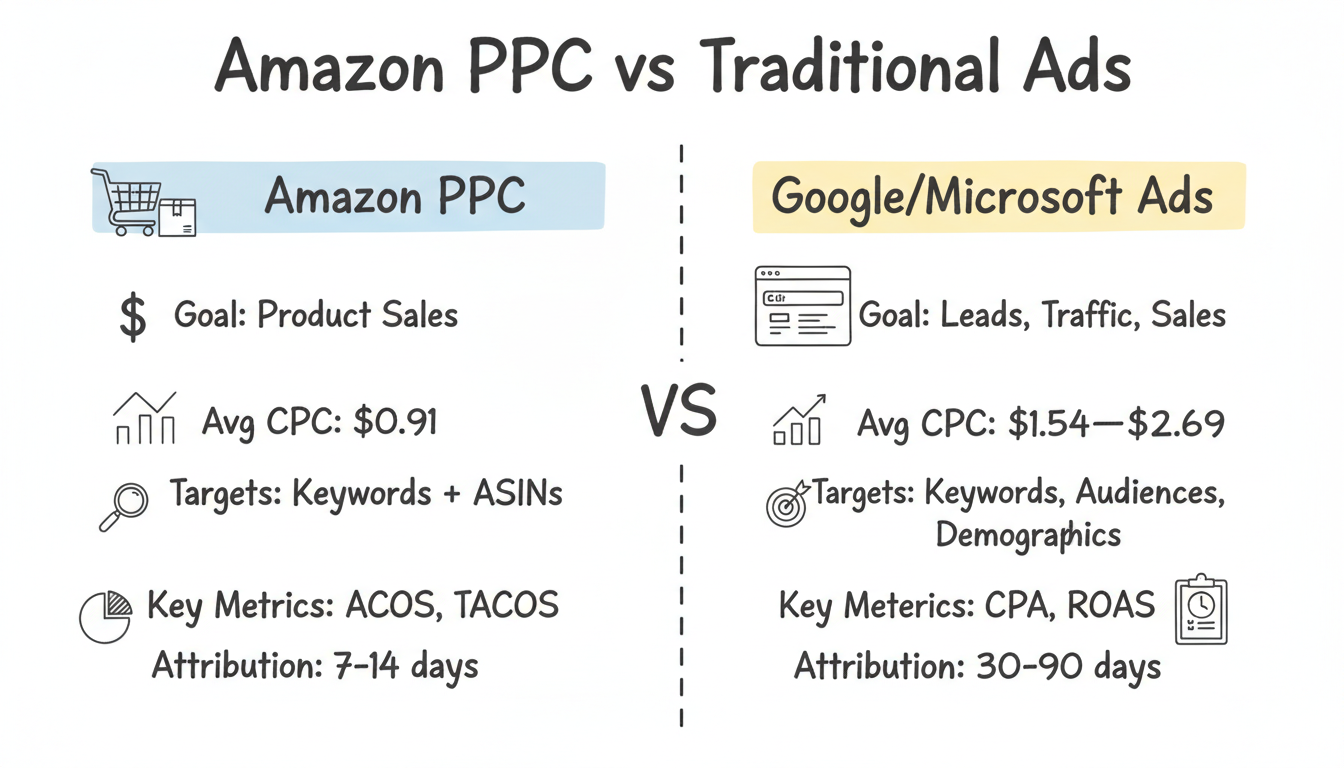
While the fundamentals of PPC apply across platforms, Amazon advertising has unique characteristics that require specialized expertise.
Feature | Amazon PPC | Microsoft/Google Ads |
Primary goal | Product sales | Leads, traffic, sales |
Average CPC | $0.91 | $1.54 - $2.69 |
Targeting basis | Product keywords, ASINs | Keywords, audiences, demographics |
Conversion tracking | Automatic (Amazon sales) | Requires setup |
Attribution window | 7-14 days typical | 30-90 days typical |
Key metrics | ACoS, TACoS | CPA, ROAS |
Why Amazon PPC requires specialized skills:
A Google Ads expert won't automatically succeed with Amazon campaigns—the ecosystem is fundamentally different. The distinction is similar to choosing between Microsoft Ads vs Facebook Ads, where each platform demands platform-specific expertise.
Amazon offers several ad formats, each serving different purposes in your advertising strategy. Understanding when to deploy each format is crucial for PPC advertising management best practices.
The workhorse of Amazon advertising. These appear in search results and product detail pages.
Aspect | Details |
Budget allocation | 70%+ of most ad budgets |
Best for | Direct product sales, keyword ranking |
Targeting | Keywords, product targeting (ASINs) |
Typical CPC | $0.50 - $1.50 |
Banner ads featuring your brand logo, headline, and multiple products.
Aspect | Details |
Budget allocation | 15-25% of budget |
Best for | Brand awareness, product portfolio |
Targeting | Keywords, categories |
Requirements | Brand Registry enrollment |
Retargeting and audience-based ads that appear on and off Amazon.
Aspect | Details |
Budget allocation | 5-15% of budget |
Best for | Retargeting, conquesting competitors |
Targeting | Audiences, product views, interests |
Reach | Amazon + third-party sites |
Programmatic display and video advertising with advanced audience targeting.
Aspect | Details |
Minimum spend | $50,000 for managed service |
Best for | Enterprise brands, full-funnel marketing |
Targeting | Amazon shopping data, lookalike audiences |
Ad formats | Display, video, OTT |
Effective Amazon PPC requires a strategic approach that accounts for product lifecycle, competition, and business goals. These fundamentals align with broader paid search advertising platforms principles but with Amazon-specific nuances.
Organize campaigns for clarity and control:
Match Type | Purpose | When to Use |
Broad | Discovery | New products, keyword mining |
Phrase | Balance | Mid-funnel, capturing variations |
Exact | Precision | Top performers, tight budget control |
Amazon offers several bidding strategies:
According to Amazon advertising research, starting with dynamic down-only bidding provides a good balance of performance and control while you gather data. This approach is particularly important when following Bing ads strategy advanced tactics adapted for Amazon's ecosystem.
Understanding these metrics is critical for evaluating Amazon PPC performance and making decisions about when to work with PPC agency services.
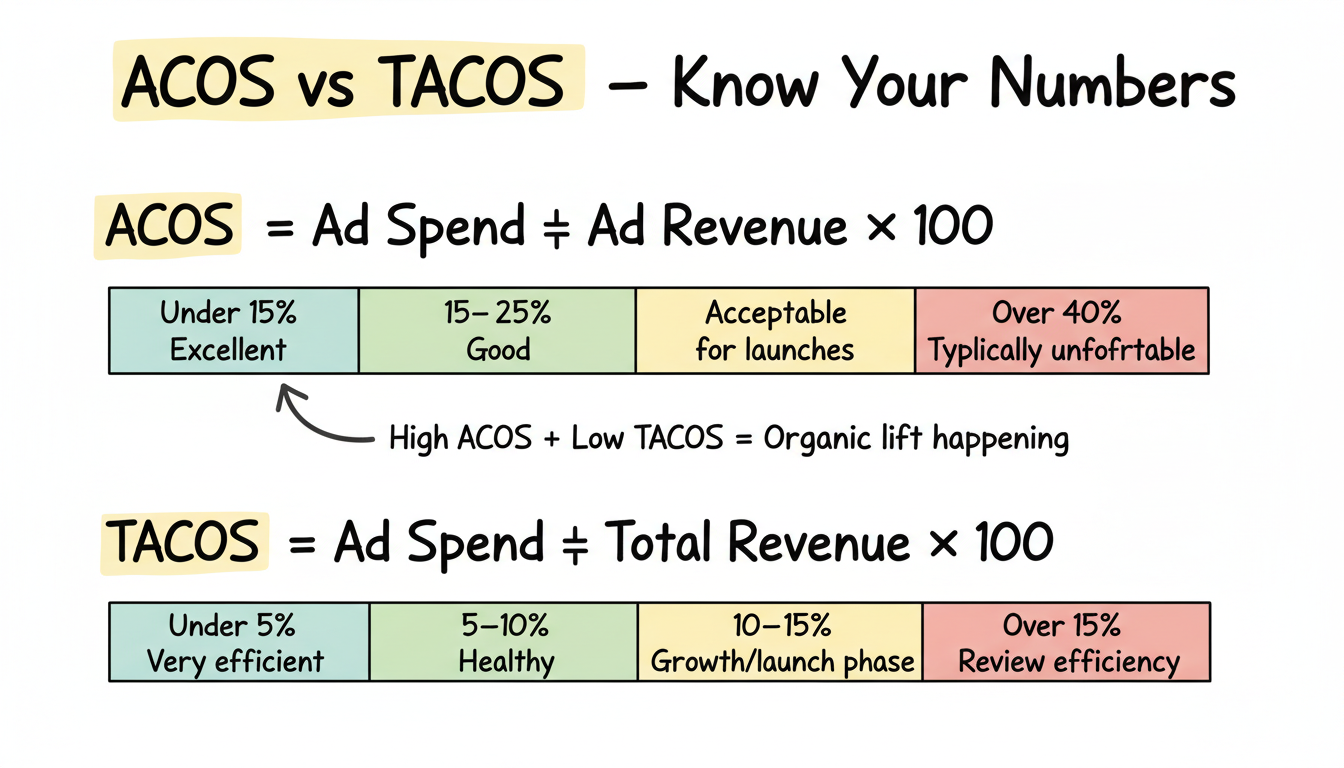
ACoS measures ad spend as a percentage of attributed ad revenue.
Formula: ACoS = (Ad Spend / Ad Revenue) × 100
ACoS Range | Interpretation |
Under 15% | Excellent (most products) |
15-25% | Good |
25-40% | Acceptable for launches/growth |
Over 40% | Typically unprofitable |
Important context: According to industry analysis, "good" ACoS depends entirely on your margins and goals. A 40% ACoS might be excellent for a new product launch but terrible for a mature product with thin margins.
TACoS measures ad spend against total revenue (organic + paid).
Formula: TACoS = (Ad Spend / Total Revenue) × 100
TACoS Range | Interpretation |
Under 5% | Very efficient |
5-10% | Healthy benchmark |
10-15% | Growth/launch phase |
Over 15% | Review efficiency |
Why TACoS matters more: TACoS reveals the true advertising burden on your business. A product with 30% ACoS but 8% TACoS is performing well because advertising is driving organic growth. This metric is particularly useful when calculating your PPC budget across multiple platforms.
Scaling Amazon advertising without sacrificing profitability requires systematic optimization, similar to approaches used in complete guide Microsoft advertising PPC campaigns.
Mistake | Why It Hurts | Solution |
Scaling too fast | Inflates ACoS, loses control | Increase budgets 20-30% weekly max |
Ignoring negative keywords | Wastes spend on irrelevant clicks | Weekly search term analysis |
Single campaign structure | Limits optimization ability | Segment by match type and purpose |
No bid adjustments | Overpays for low-value placements | Use placement modifiers strategically |
Understanding when to pivot between these modes is a core competency, whether you're managing campaigns in-house or working with Bing ads management services providers who also handle Amazon.
Professional Amazon PPC agencies provide comprehensive management that goes beyond simple bid adjustments, similar to specialized PPC advertising software tools but with human strategic oversight.
Service | What's Included |
Campaign setup | Account structure, keyword research, targeting strategy |
Daily management | Bid adjustments, budget allocation, negative keywords |
Reporting | Performance dashboards, ACoS/TACoS tracking, recommendations |
Strategy | Launch planning, competitive analysis, growth roadmaps |
Optimization | A/B testing, search term mining, placement analysis |
Many agencies also offer:
According to industry surveys, Amazon PPC agencies typically charge fees comparable to PPC agency pricing for other platforms:
Pricing Model | Typical Range | Best For |
Flat monthly fee | $501 - $3,000/month | Predictable budgets |
Percentage of spend | 10-15% of ad budget | Aligned incentives |
Percentage of sales | 3-8% of attributed revenue | Performance-based |
Hybrid | Base fee + percentage | Balance of both |
Total Amazon PPC costs: Including ad spend, most businesses invest $50 - $3,000/month for Amazon advertising, though larger catalogs and aggressive growth strategies can reach $10,000-$50,000+ monthly. Understanding Microsoft advertising cost pricing can provide helpful context for budgeting across platforms.
Selecting the right agency requires evaluating their expertise, approach, and fit for your business. The criteria differ significantly from choosing providers for PPC advertising for attorneys or other industry-specific campaigns.
Criteria | What to Look For |
Amazon specialization | Dedicated Amazon team, not generalist PPC |
Proven results | Case studies with specific ACoS/TACoS improvements |
Transparent reporting | Real-time dashboards, not just monthly PDFs |
Strategic approach | Beyond bid management to full-funnel strategy |
Communication | Dedicated account manager, regular strategy calls |
Consider whether you need a consultant who can provide strategic guidance similar to a Microsoft advertising consultant, or a full-service agency that handles day-to-day management. You might also want to hire a Bing Ads expert who understands cross-platform synergies.
Amazon PPC agency fees typically range from $501 to $3,000 per month for flat-fee arrangements, or 10-15% of your monthly ad spend for percentage-based pricing. Total investment including ad spend ranges from $1,000 to $50,000+ monthly depending on catalog size and growth goals.
A good ACoS depends on your profit margins and goals. Generally, 15-25% ACoS is considered good for established products, while new product launches may accept 30-40% ACoS to build ranking. Calculate your break-even ACoS based on your profit margin before advertising.
Most sellers see initial data within 1-2 weeks, but meaningful optimization requires 4-8 weeks of data. Full campaign maturation—where organic ranking improvements compound with advertising efficiency—typically takes 3-6 months of consistent management, similar to timelines seen with Google PPC advertising campaigns.
Amazon PPC represents just one component of a comprehensive digital marketing strategy. Sellers looking to maximize their reach should also consider SEO SEM strategies integrated marketing approaches and understand the broader landscape of types of digital marketing available to e-commerce businesses.
By submitting this form, you agree to our Privacy Policy and Terms & Conditions.