February 19, 2026


Figuring out how much Facebook ads cost per month is one of the first questions businesses ask when considering Meta advertising. The short answer: most businesses spend between $500 and $5,000 monthly, but your ideal budget depends on your goals, industry, and business stage.
In this guide, we'll break down exactly what you should expect to pay for Facebook advertising in 2026, with specific recommendations based on business size and objectives.
Facebook doesn't require a set monthly minimum—you can technically start with just $1-5 per day. However, spending too little means your campaigns won't gather enough data to optimize properly.
Here's what businesses actually spend based on 2026 industry data:
Business Stage | Monthly Ad Spend | What You Can Expect |
Testing phase | $750 - $1,500 | Limited reach, initial learning |
Growth phase | $2,000 - $4,000 | Consistent reach and optimization |
Competitive scale | $5,000+ | Market-level visibility |
To understand monthly costs, you need to know the key metrics that determine your spend:
With a $1,000 monthly budget at average CPC rates, you'd receive approximately 1,600 clicks. At a 2% conversion rate, that translates to roughly 32 leads per month. Understanding these fundamentals is essential for Facebook ads for beginners looking to maximize their investment.
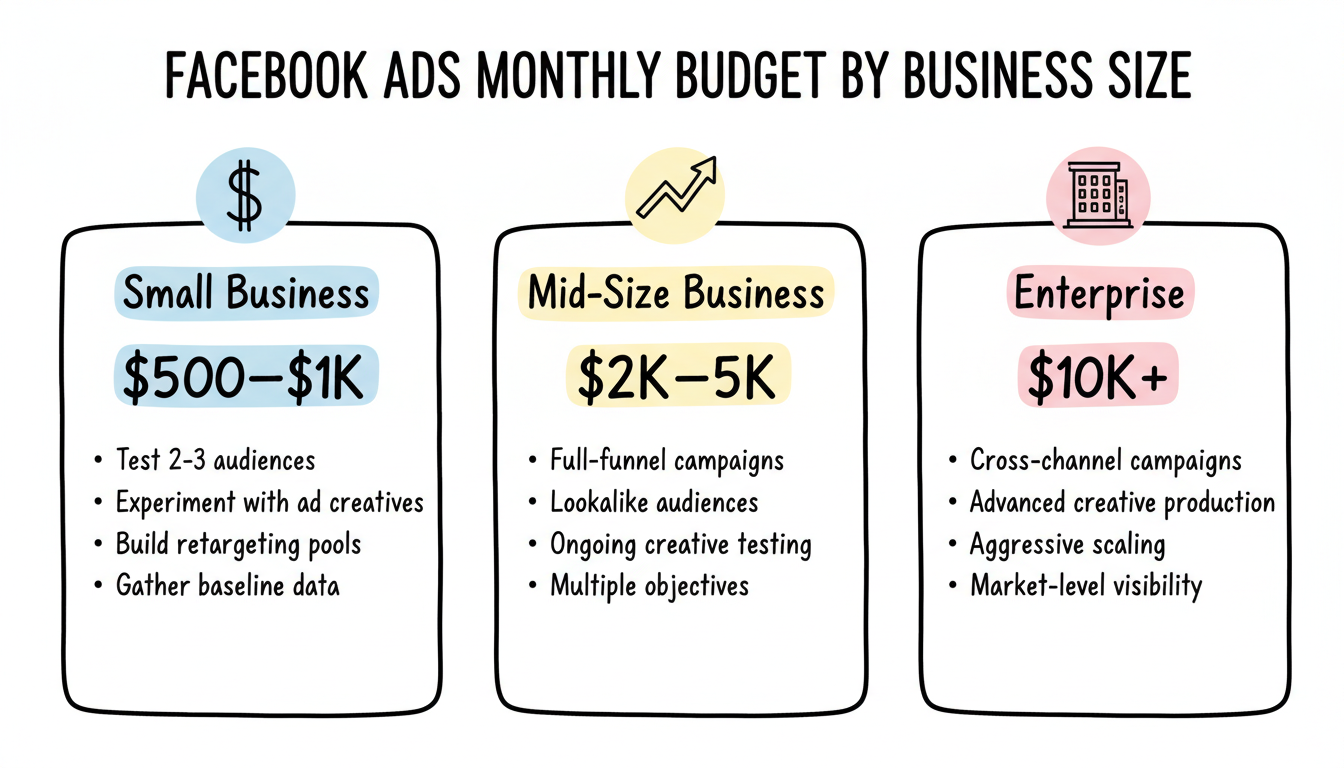
Your company's size and growth stage should influence your monthly Facebook ad investment. Here's what we recommend:
Small businesses just starting with Facebook ads should budget $500 to $1,000 per month for basic campaign testing. This budget allows you to:
Is $1,000 enough for Facebook ads? Yes, but with realistic expectations. According to industry research, you should plan to spend at least $1,000-2,000 for initial testing across 30 days to generate meaningful data. This provides enough information to evaluate which audiences and creatives perform best.
Established businesses typically invest $2,000 to $5,000 monthly in Facebook advertising. This budget enables:
At this level, implementing a comprehensive meta ads funnel strategy becomes crucial for maximizing your return on investment across all campaign stages.
Large companies with significant marketing budgets allocate $10,000 or more per month to Facebook ads. Many work with a specialized Instagram ads agency or white label Facebook ads agency to manage campaigns at this scale. At this level, you can:
Your industry significantly impacts Facebook ad costs. Some sectors face more competition, driving up costs per click and impression.
Industry | Recommended Monthly Budget | Expected CPM |
Finance & Insurance | $3,000 - $10,000 | $15 - $20 |
Legal Services | $2,500 - $8,000 | $14 - $18 |
Real Estate | $2,000 - $6,000 | $12 - $16 |
Healthcare | $1,500 - $5,000 | $10 - $14 |
E-commerce | $1,000 - $4,000 | $7 - $10 |
Food & Beverage | $500 - $2,000 | $4 - $7 |
Entertainment | $500 - $2,000 | $4 - $6 |
Competitive industries like finance and legal require higher budgets to achieve meaningful results. E-commerce businesses should also understand the nuances of Google Ads vs Facebook Ads ecommerce to allocate their marketing budget effectively across platforms.
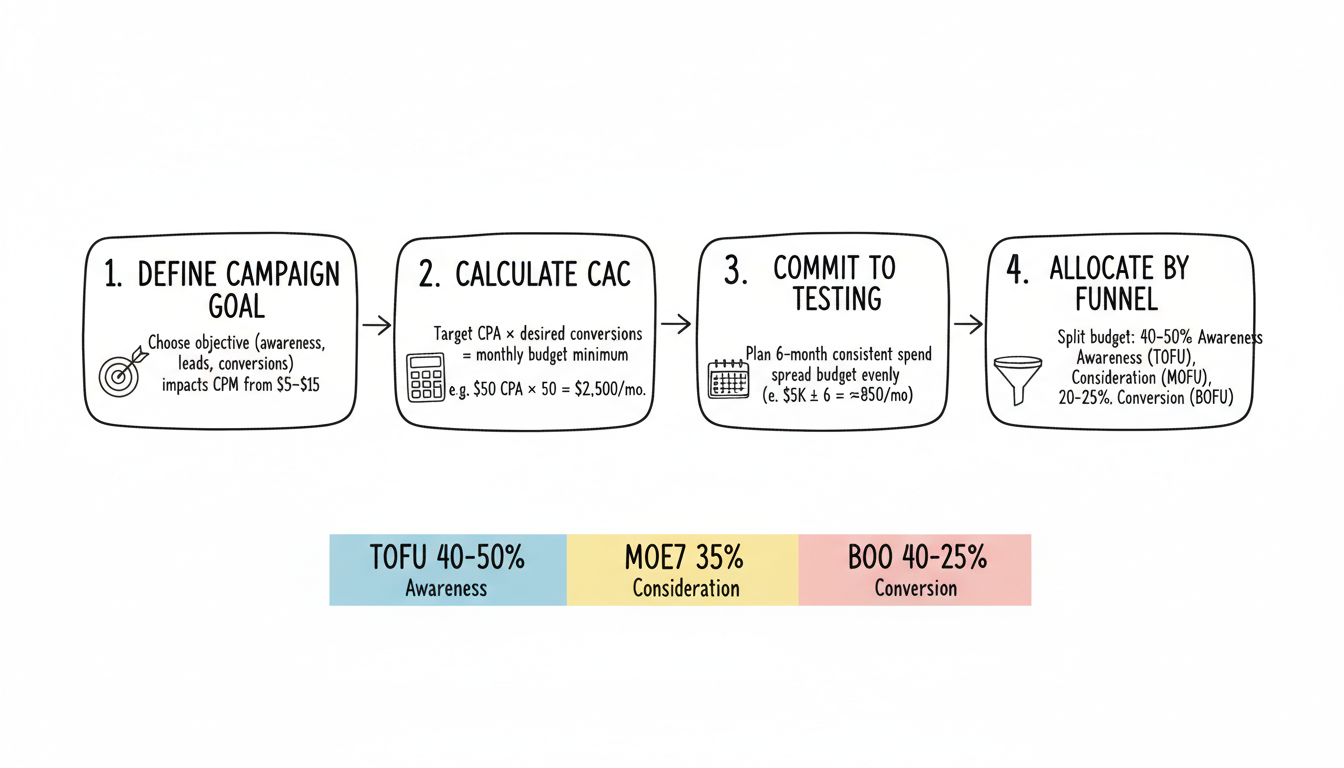
Follow this step-by-step approach to determine the right budget for your business:
Your objective determines how much you'll spend. Brand awareness campaigns typically cost less than conversion-focused campaigns:
Objective | Average CPM |
Reach | $5 - $7 |
Brand Awareness | $5 - $8 |
Engagement | $4 - $6 |
Traffic | $6 - $9 |
Lead Generation | $9 - $13 |
Conversions | $10 - $15 |
Understanding what are meta ads and their various objectives helps you choose the right campaign type for your budget.
Work backward from your target customer acquisition cost (CAC):
Example: If your target CPA is $50 and you want 50 conversions monthly, you need a minimum budget of $2,500/month. Learning how to calculate ROI Facebook ads ensures you're tracking performance accurately against these goals.
Facebook ads require time to optimize. The biggest mistake businesses make is spending their entire budget in one month and then quitting.
Instead, plan for at least 6 months of consistent spend. If you have $5,000 to invest:
This approach allows time to test audiences, creatives, and offers while building valuable retargeting pools. If you're managing client campaigns, understanding how to run Facebook ads as agency can help you set appropriate client expectations.
Allocate your monthly budget across the customer journey:
Funnel Stage | Budget Allocation | Purpose |
Awareness (TOFU) | 40-50% | Reach new audiences, build brand recognition |
Consideration (MOFU) | 30-35% | Retargeting website visitors, engagement |
Conversion (BOFU) | 20-25% | Retargeting warm leads, driving sales |
For example, with a $2,000 monthly budget:
Letting Meta optimize placement across Facebook, Instagram, Stories, and Audience Network typically delivers the lowest overall CPM. However, understanding the debate of Facebook ads vs Instagram ads vs Google ads helps you make informed decisions about where to focus your spend.
Retargeting ads are cheaper and convert better because you're reaching people who already know your brand. You can see sales traction with just $500-1,000 monthly when focused on retargeting existing website visitors. For e-commerce stores, learning how to run Facebook ads for Shopify can unlock powerful retargeting opportunities.
Meta rewards relevant ads with lower costs. Focus on:
Studying successful meta ads examples can inspire your own creative strategy while staying compliant with meta ads policy requirements.
Video ads typically achieve better engagement and lower CPMs. Even simple product demos or customer testimonials can outperform static images.
Small businesses should budget between $500 and $1,000 per month minimum to run effective Facebook ad campaigns. However, campaigns under $1,000 per month often struggle to generate meaningful data for optimization. If possible, aim for $1,500-2,000 monthly for better results. Understanding overall meta advertising cost structures helps set realistic expectations.
$100 monthly (roughly $3.30/day) is too low for most business objectives. While Meta allows budgets this small, you won't gather enough data to optimize campaigns effectively. Most experts recommend at least $500/month as a starting point for meaningful testing.
The average CPM (cost per 1,000 impressions) on Facebook is $11.62 in 2026. However, this varies significantly by industry—from $4-6 for entertainment to $15-20 for finance. Your meta ads bidding strategy directly impacts your CPM rates.
Meta allows daily budgets as low as $1-5 depending on your campaign objective. However, for practical results, most advertisers recommend starting with at least $20-50 per day, which translates to $600-1,500 per month.
Plan for at least 6 months of consistent spend to properly test, optimize, and scale your campaigns. During this time, you're testing audiences, creatives, offers, and building retargeting pools—all essential for long-term success. Many businesses also invest in a meta ads course to accelerate their learning curve and improve campaign performance faster.
By submitting this form, you agree to our Privacy Policy and Terms & Conditions.