February 19, 2026


The marketing industry faces a false choice: optimize for AI search or traditional search. In reality, the most successful brands in 2026 are doing both—integrating Generative Engine Optimization (GEO) with traditional Search Engine Optimization (SEO) into unified visibility strategies that capture traffic from every search surface.
According to WordStream's analysis of search marketing trends, GEO will surge in 2026, but traditional SEO still won't go away. The brands winning visibility today understand that GEO and SEO aren't competitors—they're complementary channels that reinforce each other when executed strategically.
Before combining these strategies, it's essential to understand what makes them distinct.
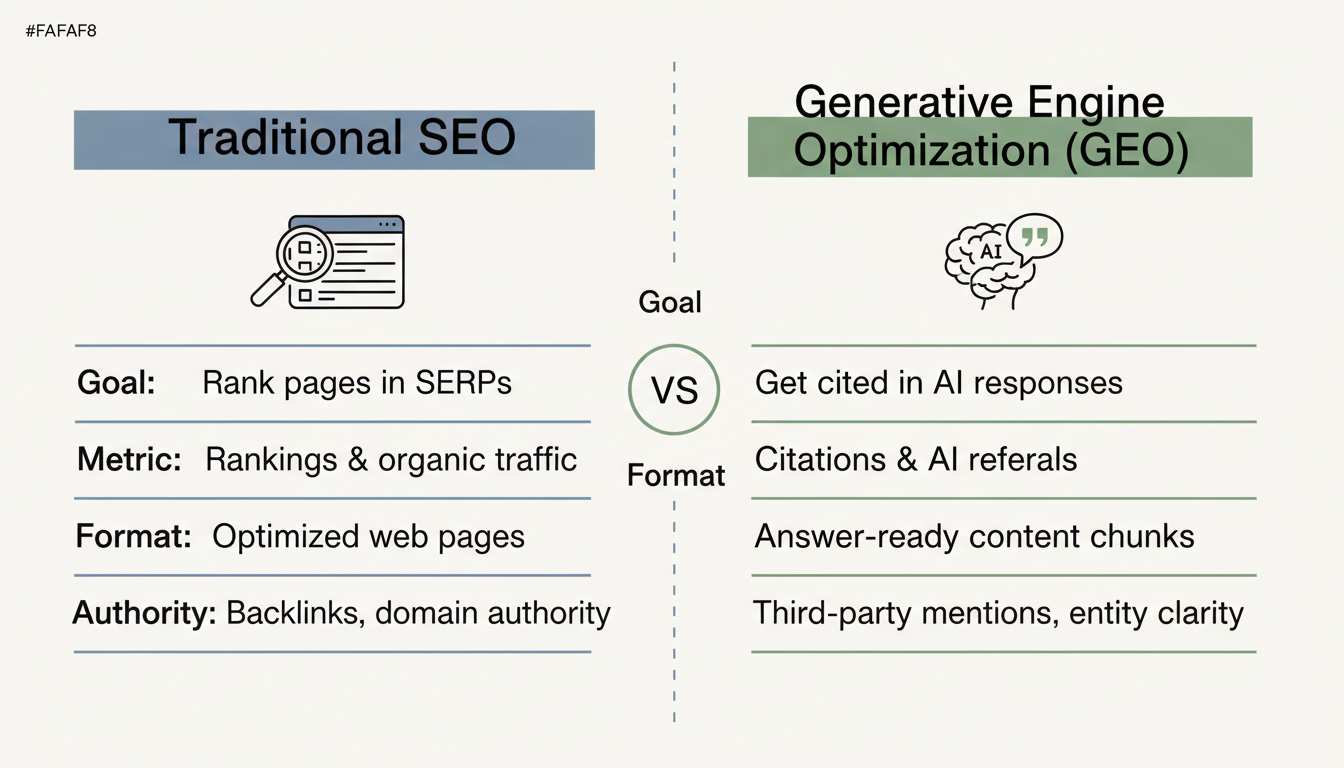
Search Engine Optimization (SEO) focuses on ranking web pages in traditional search results. It involves optimizing content, technical elements, and authority signals to earn higher positions in Google, Bing, and other search engine results pages (SERPs).
Generative Engine Optimization (GEO) focuses on getting your content cited, referenced, or recommended by AI systems like ChatGPT, Perplexity, Google AI Overviews, and Microsoft Copilot. Instead of ranking pages, GEO aims for AI systems to extract and present your information as answers.
According to Firebrand Marketing's GEO best practices guide, SEO remains the foundation of GEO—a strong SEO foundation helps GEO execution significantly. The disciplines share common principles but require different tactical approaches. Understanding the difference between SEO, AEO, GEO, and AIO helps marketers allocate resources effectively across these complementary channels.
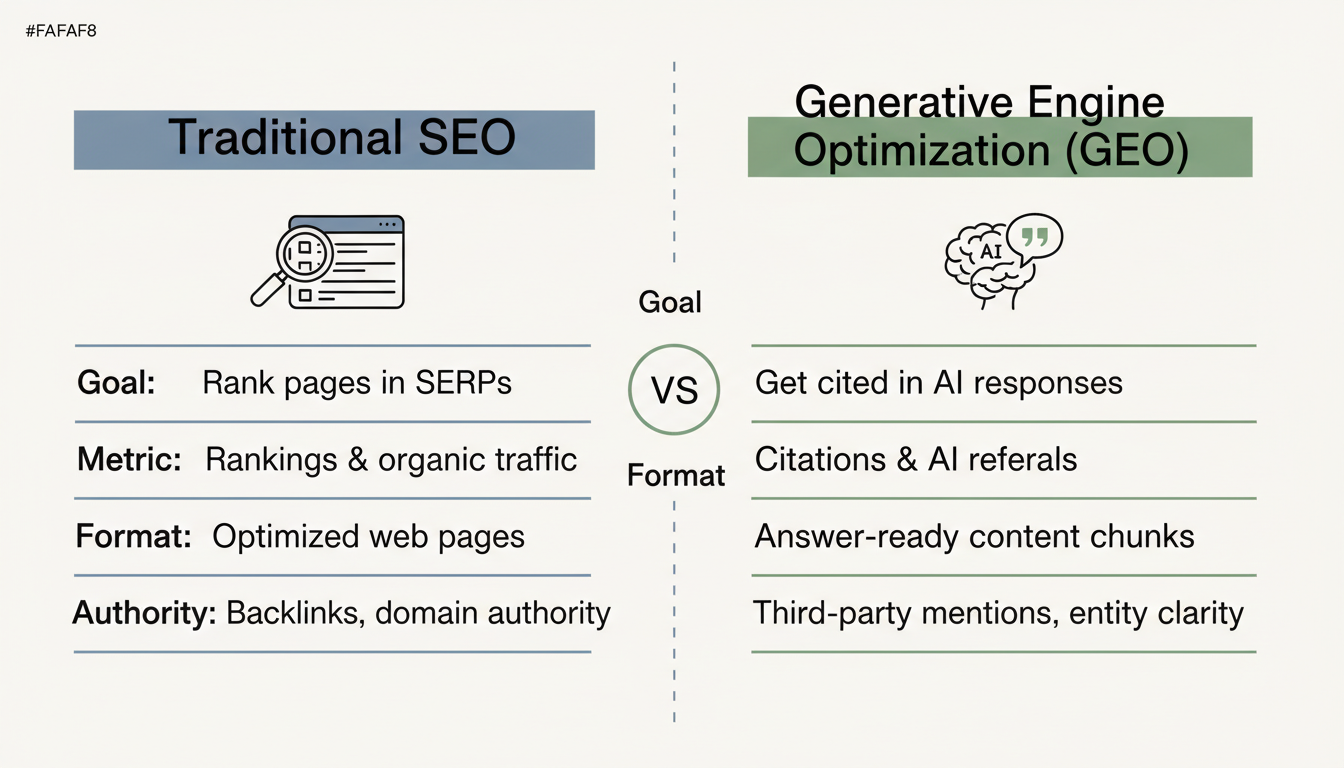
Aspect | Traditional SEO | Generative Engine Optimization |
Goal | Rank pages in SERPs | Get cited in AI responses |
Primary metric | Rankings, organic traffic | Citations, AI referrals |
Content format | Optimized web pages | Answer-ready content chunks |
Authority signals | Backlinks, domain authority | Third-party mentions, entity clarity |
User journey | Click-through to website | May receive information without clicking |
According to Conductor's 2026 AEO/GEO Benchmarks Report, AI referral traffic currently represents just over 1% of total web visits. This statistic reveals a critical insight: traditional SEO still drives the vast majority of search traffic.
According to Digital Commerce 360's traffic analysis, websites generate 34 times more traffic from Google than from AI chatbots. Abandoning SEO for GEO would mean sacrificing 97%+ of current search traffic for a channel that's still emerging.
The integration case:
According to Crossway Consulting's digital marketing predictions, the recommendation is clear: invest in AEO and GEO alongside, not instead of, traditional SEO. This integrated approach maximizes current traffic while building AI visibility for the future. Measuring the AI Overview traffic impact by industry reveals which sectors benefit most from early GEO adoption.
According to SEO.com's analysis of GEO and SEO integration, these strategies aren't just compatible—they actively strengthen each other when implemented correctly.
Content quality requirements: Both SEO and GEO reward comprehensive, authoritative content. The E-E-A-T signals that help pages rank in Google also help content get cited by AI systems. Investing in content quality serves both channels.
Technical optimization: According to WSI World's digital marketing research, structured data helps both search engines and AI systems understand your content. Schema markup that improves rich snippet eligibility also helps AI extract and cite information accurately.
Authority building: Third-party mentions, media coverage, and industry recognition strengthen both SEO (through links and brand signals) and GEO (through entity validation that AI systems verify). Implementing AI search citation tracking helps quantify which authority signals drive the most AI references.
SEO Tactic | GEO Benefit |
Quality backlinks | Validate entity authority for AI |
Topical authority | Establish expertise AI systems cite |
Technical SEO | Enable AI crawling and extraction |
Featured snippet optimization | Train content structure for AI responses |
Brand building | Strengthen entity recognition |
According to Ntooitive's GEO marketing analysis, GEO marketing isn't replacing SEO—it's transforming and expanding it. The evolution requires adapting existing strategies rather than abandoning proven approaches. Brands pursuing a comprehensive answer-engine-optimization-agency partnership can accelerate this transformation.
According to PR News Online's analysis of AI search optimization, successful integration requires a coordinated approach across content, technical, and authority-building activities.
Before integrating, understand your baseline in both channels:
SEO audit:
GEO audit:
According to Conductor's AI visibility platform guide, measurement tools now exist for both channels—use them to establish baselines before optimization.
According to StoreTransform's research on GEO, the greatest efficiency comes from identifying content that can serve both channels simultaneously.
High-overlap content types:
These formats naturally work for both traditional search rankings and AI extraction. Prioritize them for unified optimization. Leveraging AEO content templates ensures consistency across both traditional and AI search optimization efforts.
According to Firebrand Marketing, content structure matters for both channels. Use clear headings, bullet points, tables, and FAQ sections that help both search engines and AI systems understand and extract your information.
Dual-purpose content structure:
According to ALM Corp's schema and structured data guide, technical implementation serves both GEO and SEO goals.
Priority technical elements:
Element | SEO Impact | GEO Impact |
Organization schema | Knowledge Panel eligibility | Entity recognition |
FAQPage schema | FAQ rich results | Q&A extraction |
Article schema | Content type signals | Authorship attribution |
Breadcrumb schema | Site structure clarity | Topical context |
Site speed optimization | Core Web Vitals | Crawl efficiency |
Brands comparing AI SEO vs traditional SEO approaches find that technical foundations serve both channels equally well.
According to Search Engine Journal's 2026 SEO predictions, authority signals are shifting but remain essential. Build authority that both search algorithms and AI systems can verify.
Unified authority building:
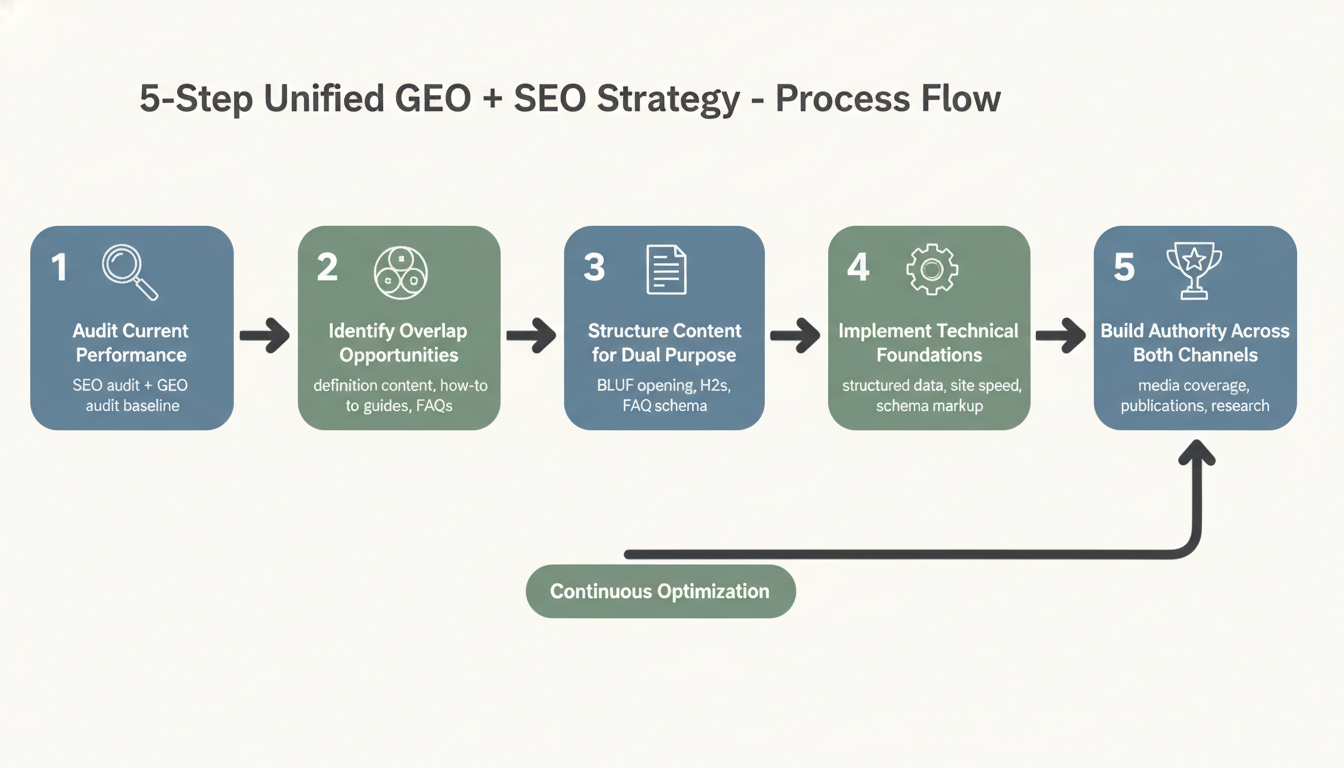
According to LinkedIn's analysis of GEO trends, successful GEO + SEO integration requires cross-functional coordination beyond the SEO team.
Team integration requirements:
Team | SEO Contribution | GEO Contribution |
Content | Keyword-optimized articles | Answer-ready content chunks |
PR | Link-building campaigns | Third-party mention generation |
Product Marketing | Feature content | Entity-rich descriptions |
Social | Distribution | Platform presence validation |
Customer Success | Testimonials | Case study content |
According to New Target's digital marketing predictions, 2026 will see GEO becoming a cross-functional marketing discipline rather than an SEO-only responsibility. Teams exploring answer engine optimization tools can coordinate efforts more effectively across departments.
According to Conductor's benchmarks report, measurement frameworks must evolve to capture both channels effectively.
SEO metrics:
GEO metrics:
Unified metrics:
According to LLMrefs' AI visibility research, tracking both channels reveals optimization opportunities that single-channel measurement would miss. Understanding the AEO optimization timeline helps set realistic expectations for when integrated strategies deliver measurable results.
According to Web Pro News' analysis of SEO evolution, several common mistakes undermine GEO + SEO integration efforts.
Mistakes to avoid:
According to TheeDigital's digital marketing analysis, the biggest mistake is treating GEO as a replacement rather than an extension of existing SEO work. Reviewing AEO services case studies reveals how successful brands avoid these pitfalls.
According to Exploding Topics' analysis of AI search trends, several integration priorities should guide 2026 strategy.
Restructure existing high-performing SEO content for AI extraction. Add clear definitions, FAQ sections, and answer-ready paragraphs to pages already ranking well.
Strengthen entity signals that serve both channels: consistent NAP data, comprehensive schema, verified profiles, and cross-platform brand consistency. Understanding GEO meaning in marketing clarifies which entity signals matter most for AI visibility.
Build authority signals beyond backlinks. Media coverage, industry publications, and third-party mentions validate entities for AI while supporting SEO.
Implement tracking for both channels. Without visibility into AI citations alongside organic traffic, optimization decisions lack complete data. Conducting AI SEO software ROI testing justifies investment in unified measurement platforms.
Ensure content, PR, product, and marketing teams understand their roles in unified search visibility. GEO success requires coordination beyond SEO specialists.
Integrating GEO and SEO delivers superior results to single-channel approaches:
According to WordStream, the brands that will win in 2026 are those building unified strategies that capture visibility wherever their audiences search—traditional engines, AI chatbots, voice assistants, and emerging platforms alike.
The question isn't GEO or SEO. It's how effectively you can integrate both into a comprehensive search visibility strategy.
By submitting this form, you agree to our Privacy Policy and Terms & Conditions.