February 19, 2026


Creating content that AI systems can understand, extract, and cite requires specific structural patterns. In 2026, the difference between content that earns AI citations and content that remains invisible often comes down to how information is organized—not just what information is presented.
These ready-to-use templates provide the frameworks proven to earn visibility in AI-powered search results.
AI systems process content differently than humans. While humans can extract meaning from loosely structured prose, AI engines perform better with predictable patterns:
Human Reading | AI Processing |
Tolerates varied structures | Prefers consistent patterns |
Infers meaning from context | Extracts explicit statements |
Navigates complex narratives | Parses modular sections |
Appreciates creativity | Rewards clarity |
Templates encode the structural patterns AI prefers, making your content more extractable and citable. Understanding how to use Google AI Overview capabilities effectively begins with implementing these proven frameworks.
Content using AEO-optimized templates typically achieves:
Brands implementing AEO for SaaS companies see particularly strong results when applying these templates to technical documentation and product explainers.
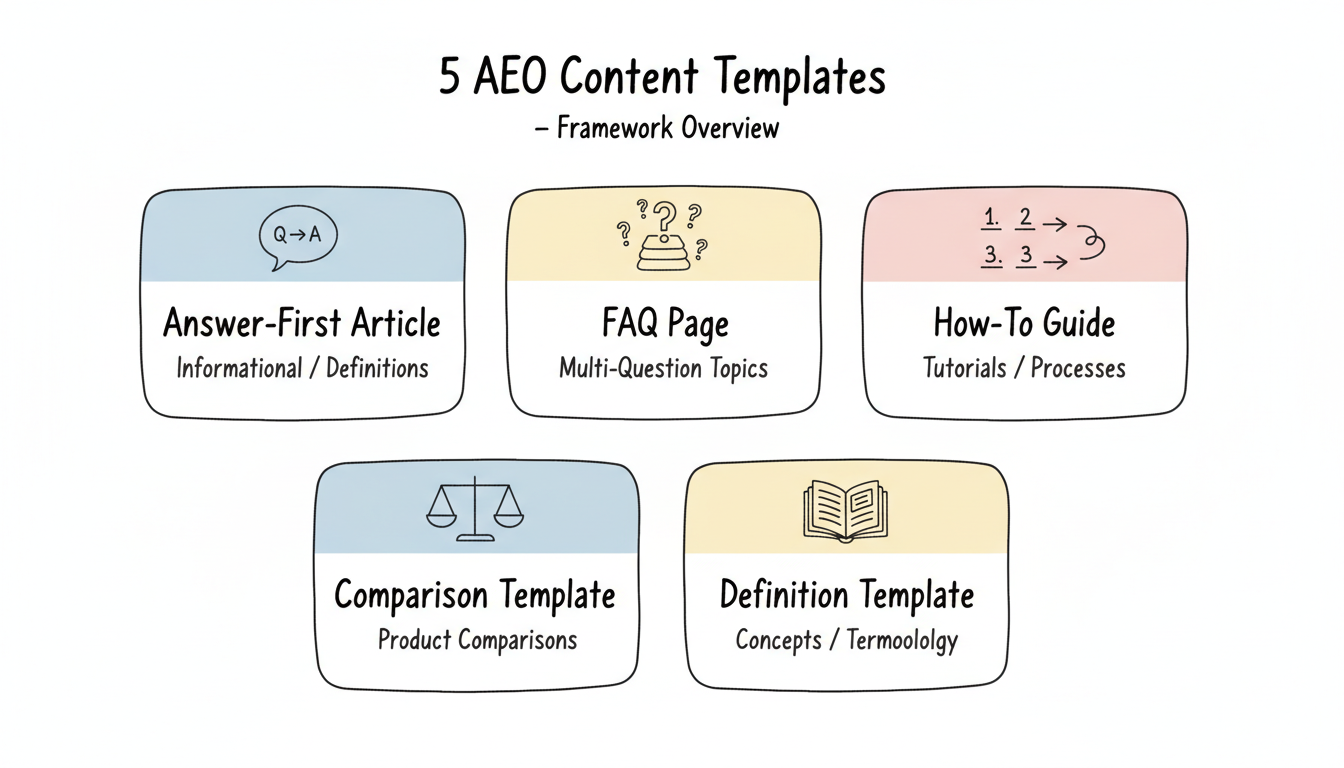
Best for: Informational queries, definitions, explanations
This template front-loads the answer, then expands with supporting detail.
## [Question as H2 Heading]

[Direct answer in 1-2 sentences - this is what AI extracts]

[Expanded explanation - 2-3 paragraphs providing context]

### [Supporting Subtopic]
[Additional detail organized in subsections]

### [Related Consideration]
[Secondary information that adds depth]
## What Is Answer Engine Optimization?
Answer Engine Optimization (AEO) is the practice of structuring content
so AI search systems can easily understand, extract, and cite it as
direct answers to user queries.
Unlike traditional SEO that focuses on ranking in search results,
AEO optimizes for visibility within AI-generated responses. This
includes Google AI Overviews, ChatGPT responses, Perplexity answers,
and voice assistant replies.
### Why AEO Differs from Traditional SEO
Traditional SEO targets the "best page" for a topic. AEO targets
the "best answer" for a specific question...
### When to Prioritize AEO
Brands should prioritize AEO when their audience increasingly
uses AI assistants for research...This pattern works especially well when combined with GEO AI SEO strategies that emphasize entity recognition and semantic clarity.
Best for: Multi-question topics, product pages, service explanations
FAQ format aligns naturally with how AI answers questions, making it highly extractable. Many generative AI SEO software platforms recommend this structure as a foundational optimization technique.
## Frequently Asked Questions

### [Question 1 - exactly as users ask it]

[Direct answer in 1-2 sentences]

[Brief expansion if needed - maximum 3-4 sentences]

### [Question 2]

[Direct answer]

[Brief expansion]

[Continue pattern for all questions]
{
"@context": "https://schema.org",
"@type": "FAQPage",
"mainEntity": [{
"@type": "Question",
"name": "What is AEO content optimization?",
"acceptedAnswer": {
"@type": "Answer",
"text": "AEO content optimization structures content so AI search
engines can easily extract and cite it as direct answers
to user queries."
}
}]
}Using proper schema markup validators AEO tools ensures your FAQ schema is correctly implemented before publishing.
## Frequently Asked Questions

### How much does AEO consulting cost?

AEO consulting typically costs $2,000-$10,000 per month depending
on scope. Project-based engagements range from $5,000 for audits
to $50,000+ for comprehensive implementation.

Pricing factors include current AI visibility, competitive landscape,
content volume, and technical complexity.

### How long before AEO shows results?

Most brands see measurable AI visibility improvements within 8-12
weeks of implementing AEO strategies. Full results typically
manifest over 3-6 months as content indexes and AI systems
update their knowledge bases.Leading enterprise AI SEO platforms provide automated FAQ schema generation to streamline this implementation process.
Best for: Instructional content, tutorials, process explanations
Step-by-step format matches AI's preference for sequential, actionable information. This approach is central to effective search engine optimization AI strategies.
## How to [Action] [in Timeframe/Context]

[Brief introduction - why this matters, who it's for - 2 sentences max]

### Step 1: [Action Verb + Specific Task]

[What to do - 1-2 sentences]

[Why it matters or tips - 2-3 sentences]

### Step 2: [Action Verb + Specific Task]

[What to do]

[Why or tips]

[Continue for all steps]

### Common Mistakes to Avoid

- [Mistake 1]: [Brief explanation]
- [Mistake 2]: [Brief explanation]

### Expected Results

[What success looks like after completing these steps]
{
"@context": "https://schema.org",
"@type": "HowTo",
"name": "How to Optimize Content for AI Search",
"step": [{
"@type": "HowToStep",
"name": "Audit current AI visibility",
"text": "Use AI visibility tools to assess how often your
brand is cited in AI-generated responses."
}]
}## How to Optimize a Blog Post for AI Overviews
This process transforms existing blog content into AI-citable
articles in approximately 30 minutes per post.
### Step 1: Restructure with Answer-First Format
Move your main answer to the opening paragraph. AI extracts
early content more reliably than buried conclusions.
Review your first 100 words—they should directly answer the
query the post targets.
### Step 2: Add Question-Based Subheadings
Convert generic headings into questions. "Pricing" becomes
"How Much Does [Service] Cost?"
This matches how users query AI assistants and improves
extraction accuracy.
### Step 3: Implement Relevant Schema Markup
Add Article schema at minimum. Include FAQ or HowTo schema
if content structure supports it.
Validate using Google's Rich Results Test before publishing.Best for: Product comparisons, alternative evaluations, decision support
Comparison format addresses high-intent queries that AI frequently answers. When evaluating platforms, many marketers reference AI search platform comparison data to inform their template selection.
## [Option A] vs [Option B]: [Key Differentiator]

[Summary statement - which is better for which use case]

### Quick Comparison

| Feature | [Option A] | [Option B] |
|---------|-----------|-----------|
| [Feature 1] | [Value] | [Value] |
| [Feature 2] | [Value] | [Value] |
| [Feature 3] | [Value] | [Value] |

### Choose [Option A] If...

- [Scenario 1]
- [Scenario 2]
- [Scenario 3]

### Choose [Option B] If...

- [Scenario 1]
- [Scenario 2]
- [Scenario 3]

### Detailed Analysis

#### [Comparison Dimension 1]
[Analysis with specific details]

#### [Comparison Dimension 2]
[Analysis with specific details]

### Our Recommendation

[Clear recommendation with rationale]
## AEO vs SEO: Which Should You Prioritize?
Prioritize SEO if you need organic traffic foundation; add AEO
if your audience increasingly uses AI assistants for research.
### Quick Comparison
| Aspect | SEO | AEO |
|--------|-----|-----|
| Primary goal | Rank in search results | Appear in AI answers |
| Success metric | Clicks and rankings | Citations and visibility |
| Timeline | 3-12 months | 2-6 months |
| Content focus | Comprehensive coverage | Answer-ready sections |
### Choose SEO If...
- You lack organic search foundation
- Your audience primarily uses traditional search
- You need traffic volume over citation quality
### Choose AEO If...
- You already rank well organically
- Your audience uses AI assistants for research
- Brand visibility in AI responses matters strategically
### Our Recommendation
Most brands should maintain SEO investment while layering AEO
optimization on top. AEO builds on SEO foundation—the two
work together rather than competing.Understanding GEO optimization techniques can enhance comparison content by improving entity disambiguation and contextual clarity.
Best for: Concept explanations, terminology, foundational content
Definition format targets the "what is" queries that AI frequently answers. Implementing schema markup alignment AEO best practices ensures your definitions are properly structured for extraction.
## What Is [Term]? [Brief Context]

**[Term]** is [one-sentence definition that could stand alone].

[Expanded explanation - 2-3 sentences adding nuance]

### Key Characteristics

- **[Characteristic 1]**: [Brief explanation]
- **[Characteristic 2]**: [Brief explanation]
- **[Characteristic 3]**: [Brief explanation]

### [Term] vs [Related Concept]

[Brief differentiation - 2-3 sentences]

### Examples of [Term]

- [Example 1]
- [Example 2]
- [Example 3]

### Why [Term] Matters

[Brief explanation of significance - 2-3 sentences]
## What Is Generative Engine Optimization (GEO)?
**Generative Engine Optimization (GEO)** is the practice of
optimizing content so AI systems cite and reference it when
generating responses to user queries.
GEO extends beyond traditional search optimization by focusing
on how AI language models select, synthesize, and present
information. Success is measured by citation frequency and
brand visibility within AI-generated content.
### Key Characteristics
- **Citation-focused**: Success measured by AI references
- **Entity-centric**: Emphasizes brand and topic recognition
- **Trust-dependent**: Requires demonstrated authority
### GEO vs AEO
GEO focuses on being cited by AI generators; AEO focuses on
being surfaced as direct answers. GEO is broader, encompassing
all AI content generation; AEO specifically targets answer
engine visibility.
### Examples of GEO
- Earning citations in ChatGPT responses
- Appearing in Perplexity's source references
- Being included in AI content tool outputsExploring the history of AEO provides valuable context for understanding how definition templates evolved to meet AI extraction requirements.
Comprehensive SEO for generative AI approaches integrate template implementation with broader technical optimization efforts.
Mistake | Problem | Solution |
Burying the answer | AI extracts early content | Move answer to first paragraph |
Generic headings | Harder for AI to match queries | Use question-format headings |
Missing schema | Reduced AI signals | Implement relevant schema types |
Over-lengthy sections | AI may truncate or skip | Keep sections modular and concise |
No clear structure | AI struggles to parse | Use consistent formatting patterns |
Yes. Many articles benefit from combining templates—for example, an answer-first introduction followed by how-to steps, then FAQ sections. Maintain consistent formatting within each template type.
Templates improve extraction probability but don't guarantee citations. AI systems also evaluate authority, accuracy, freshness, and relevance. Templates are one optimization layer among several.
Templates work best for informational and instructional content. Creative content, thought leadership, and narrative pieces may benefit from more flexible structures while still incorporating answer-first elements where appropriate.
By submitting this form, you agree to our Privacy Policy and Terms & Conditions.