February 19, 2026


Marketing agencies face a persistent challenge: clients want comprehensive digital services, but building expertise across every channel requires significant investment in talent, training, and tools. White label PPC services offer a solution—letting agencies expand their paid search capabilities without the overhead of an in-house team.
This guide covers what white label PPC means for marketing agencies, how to evaluate potential partners, and strategies for maintaining profitable client relationships while outsourcing campaign management.
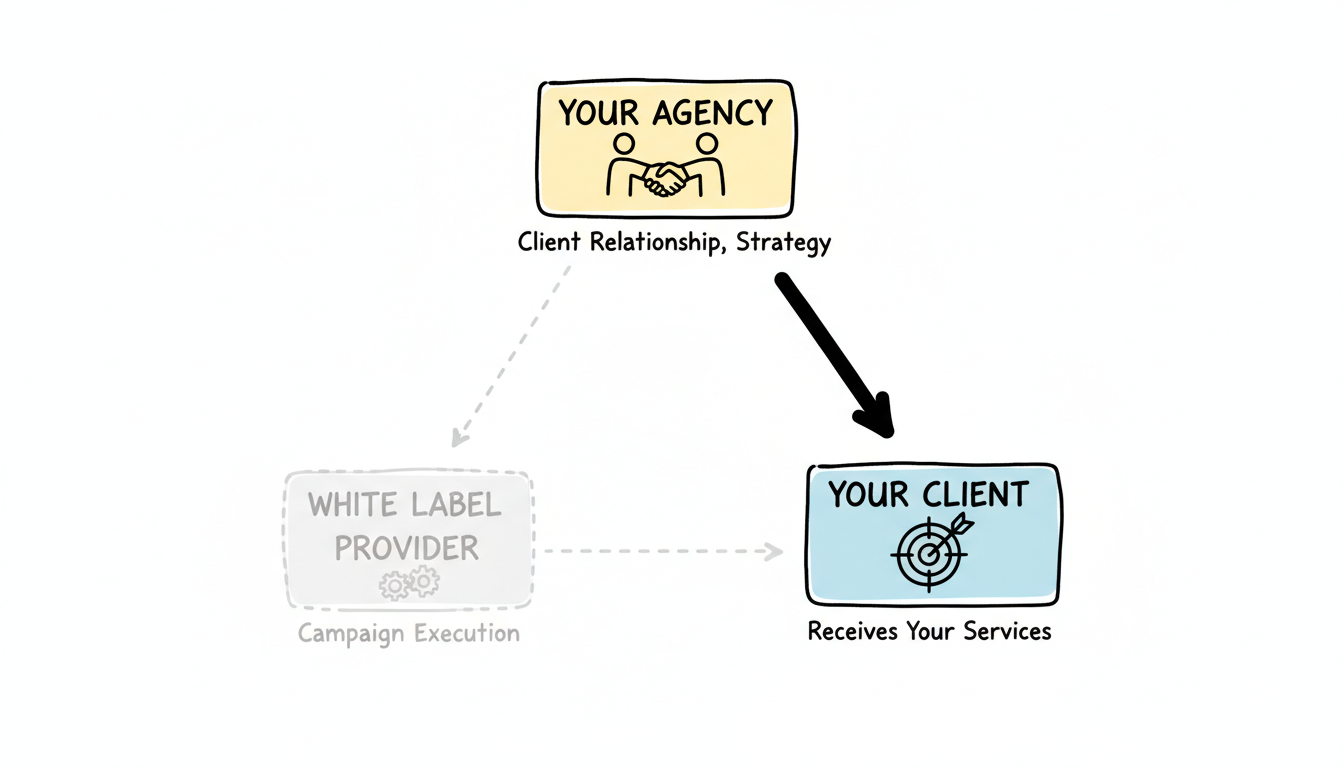
White label PPC is a B2B arrangement where a specialized PPC provider manages campaigns on behalf of a marketing agency. The work is delivered under the agency's brand—clients never know a third party is involved.
Think of it as outsourcing PPC management while maintaining complete ownership of the client relationship. The white label provider handles the technical execution: keyword research, campaign builds, bid management, optimization, and reporting. You focus on client acquisition, strategy, and relationship management.
With a referral model, you send clients to another agency and receive a commission. You lose the relationship and ongoing revenue.
White label keeps clients on your roster. You remain their primary contact, set the strategy, and control the relationship. The fulfillment partner operates invisibly behind the scenes.
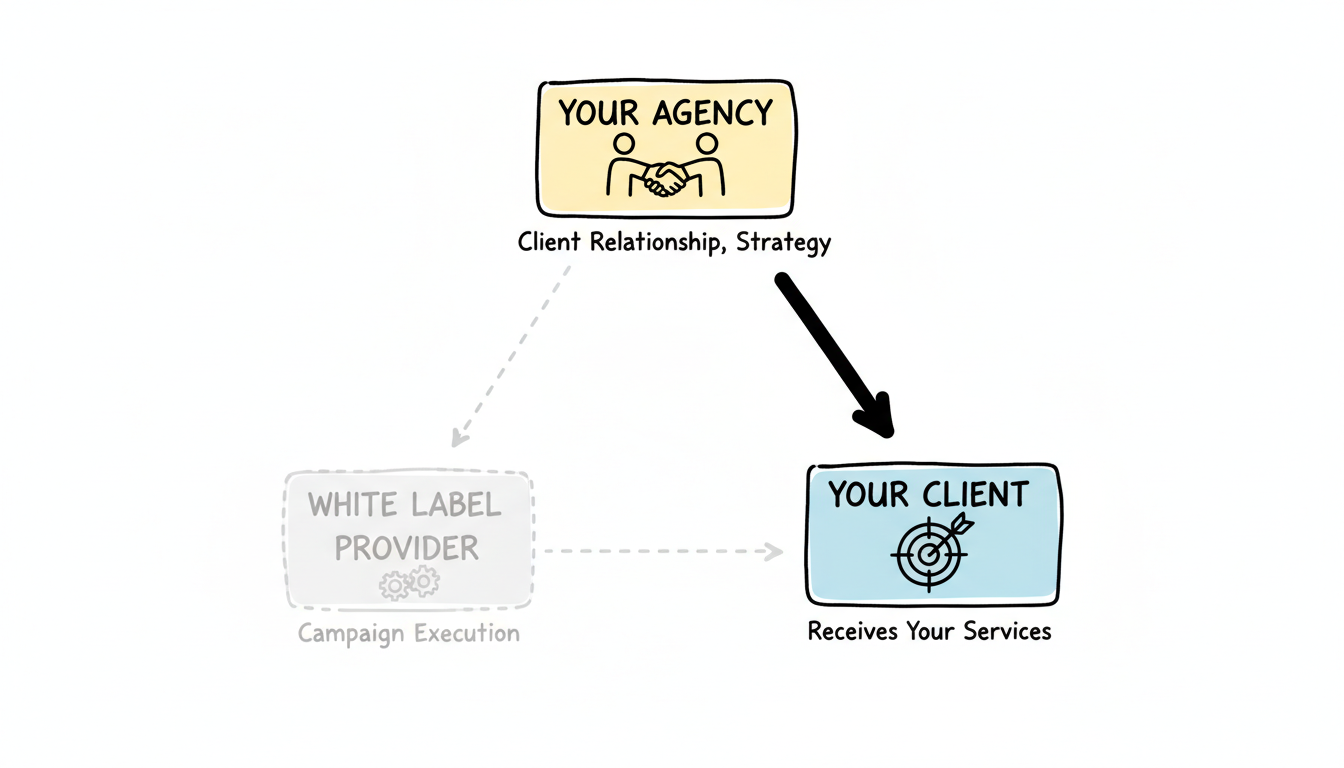
Party | Role |
Your Agency | Client relationship, sales, strategy, account management |
White Label Provider | Campaign execution, optimization, technical reporting |
Your Client | Receives services branded as yours |
Your client believes they're working exclusively with your agency. The white label partner remains invisible.
White label PPC partnerships create advantages that are difficult to replicate with internal hires alone.
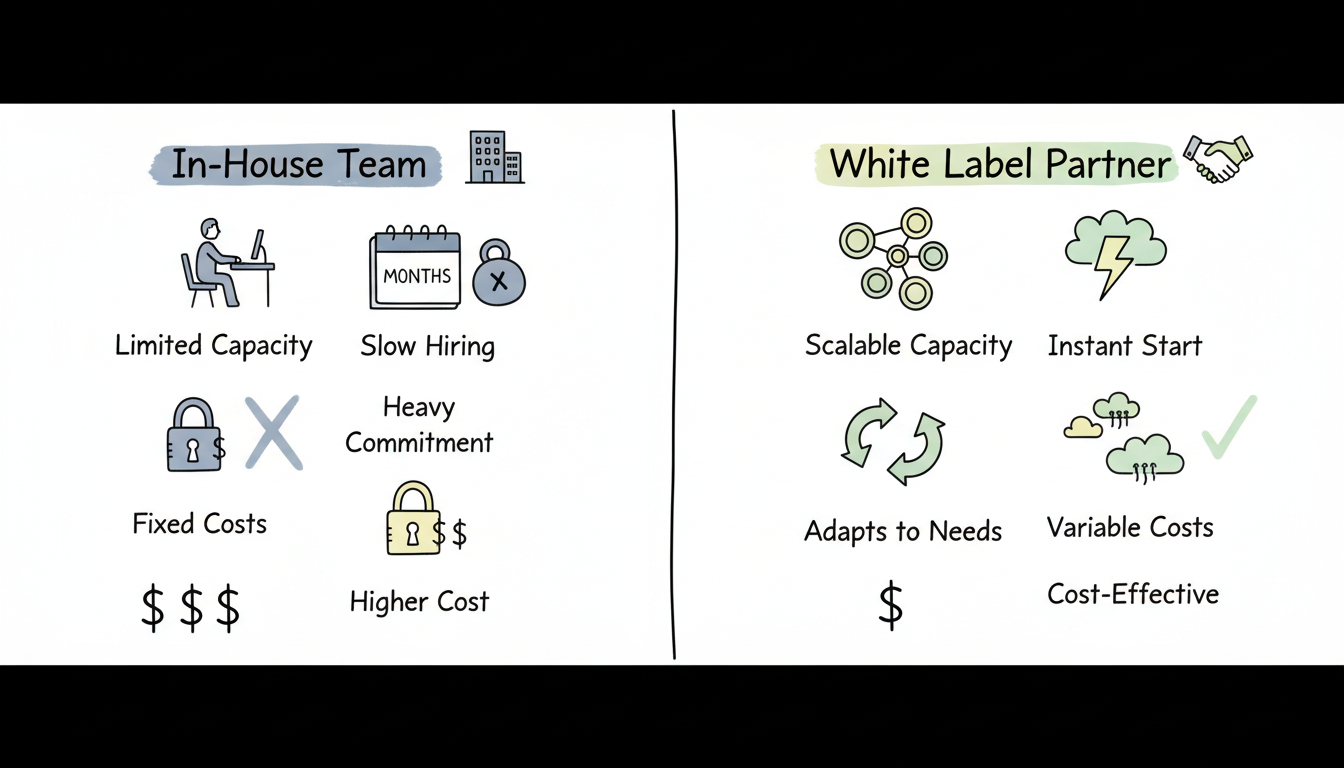
Building an internal PPC team requires recruiting specialists, providing ongoing training, investing in tools, and managing additional overhead. A single Google Ads specialist in the US costs $60,000-$90,000 annually in salary alone—before benefits, tools, and management time.
White label services enable agencies to scale operations quickly, accommodating more clients without proportional staff increases. Take on five new PPC clients next month without hiring anyone.
PPC platforms evolve constantly. Google Ads and Microsoft Advertising release new features, change algorithms, and deprecate functionality regularly. Staying current requires dedicated attention.
White label partners specialize exclusively in paid search. They live in these platforms daily and adapt immediately to changes. Your clients benefit from specialist-level expertise without you maintaining that expertise internally.
Many agencies specialize in SEO, creative, or web development but lack PPC capabilities. White label partnerships let you offer a broader range of digital marketing solutions without building new competencies from scratch. Just as agencies explore various types of digital marketing to expand their service portfolios, white label PPC represents a low-risk way to add paid search expertise.
When a client asks "do you handle paid search?" the answer becomes yes—backed by genuine capability, not empty promises.
Every hour your team spends learning Google Ads is an hour not spent on what you do best. White label arrangements let you concentrate resources on your differentiators while trusted partners handle fulfillment in adjacent areas.
The build-versus-buy decision depends on your agency's situation, growth trajectory, and strategic priorities.
You have consistent, high-volume PPC work. If you're managing $500,000+ in monthly ad spend across stable clients, dedicated staff become cost-effective.
PPC is a core differentiator. If paid search expertise defines your market position, keeping that capability internal protects your competitive advantage.
You have management capacity. PPC specialists need oversight, career development, and technical mentorship. Someone must manage the team.
You're testing the market. Before committing to hires, white label lets you validate client demand with minimal risk.
Growth is unpredictable. White label scales up and down with your client roster. Employees don't.
You lack PPC expertise. Hiring your first PPC specialist without understanding the role makes quality assessment difficult. Partners can bridge that gap.
Factor | In-House | White Label |
Specialist salary | $60,000-$90,000/year | $0 |
Tools & software | $5,000-$15,000/year | Included |
Training & development | $2,000-$5,000/year | Included |
Management overhead | Significant | Minimal |
Scaling speed | Months (hiring) | Immediate |
Risk if client churns | Fixed cost remains | Variable cost adjusts |
Comprehensive white label PPC partnerships cover the full campaign lifecycle.
Campaign setup and structure. Initial builds including account architecture, campaign organization, ad group structure, and conversion tracking implementation.
Keyword research. Identifying target keywords, mapping search intent, and building negative keyword lists. Understanding the types of search engine marketing helps partners structure campaigns appropriately for each advertising channel.
Ad creation. Writing responsive search ads, testing variations, and ongoing creative optimization.
Bid management. Implementing manual or automated bidding strategies, adjusting for performance targets.
Ongoing optimization. Regular adjustments based on performance data—pausing underperformers, scaling winners, testing new approaches. Effective PPC advertising strategy best practices guide this optimization process.
Most white label providers support multiple platforms:
Platforms like Adalysis offer white-label PPC management for both Google Ads and Microsoft Ads accounts with over 100 automated daily checks. If you need specialized Microsoft ads PPC agency services or Bing ads management services, ensure your white label partner has platform-specific expertise.
White label providers typically deliver reports branded with your agency's logo and colors. These might include:
Some agencies prefer to receive raw data and create their own client-facing reports for additional customization. Strong Microsoft ads reporting metrics should be included regardless of which platform you're advertising on.
Understanding pricing structures helps you evaluate partners and maintain healthy margins. When considering PPC agency pricing what to expect, these models represent industry standards.
The most common model charges 10-20% of monthly ad spend for management. A client spending $10,000 monthly on ads would pay $1,000-$2,000 in management fees to the white label provider.
Pros: Scales naturally with client budgets; aligns provider incentives with performance.
Cons: Smaller accounts become unprofitable for providers; may encourage spend increases.
Fixed monthly fees—typically $500-$5,000+—provide predictable costs regardless of ad spend fluctuations.
Pros: Budget certainty; works well for stable accounts.
Cons: May not scale appropriately; high retainers make small clients unprofitable.
Providers offer standardized packages (Basic, Professional, Enterprise) with different service levels and account caps.
Pros: Simplifies decision-making; clear deliverable expectations.
Cons: May not perfectly fit all client needs; potential overpaying or underserving.
Combining a base retainer with percentage-based fees provides stability while scaling with client growth.
Example: $500 base + 10% of spend over $5,000.
Target minimum 30-50% margins on white label services. If you pay a provider $1,000 to manage a client's campaigns, charge your client $1,500-$2,000.
Factor in your costs:
Not all white label providers deliver equal quality. Vet potential partners carefully.
Platform certifications. Look for Google Partner and Microsoft Advertising Partner status. These indicate platform expertise, training requirements, and performance standards. If you need a Microsoft advertising consultant or someone to hire as a Bing ads expert, certifications validate their credentials.
Proven track record. Request case studies with specific metrics. Vague claims about "increased performance" signal weak results. Review Microsoft ads case studies or similar documentation demonstrating real results.
Communication quality. Test their responsiveness during the sales process. Slow or unclear communication doesn't improve after you sign.
Reporting capabilities. Review sample reports. Ensure they're comprehensive enough for your clients and customizable to your brand.
Specialization match. Some providers excel at e-commerce, others at lead generation or specific industries. Match their strengths to your client base. For example, if you serve e-commerce clients, look for providers experienced with Amazon PPC agency services.
White labeling only works when clients remain satisfied with your agency—not aware of or loyal to your fulfillment partner.
Don't completely disappear from campaign oversight. Regular involvement keeps you informed and positions you as the strategic leader:
Understanding what is SEM marketing and broader paid search advertising strategies helps you provide strategic guidance even when outsourcing tactical execution.
Finding the right white label fit matters—ensure your partner operates as an extension of your team without offering overlapping services or inadvertently competing for your clients.
Contractual protections should include:
Some agencies allow limited white label partner interaction with clients under specific circumstances:
If you permit this, establish ground rules: the partner represents your agency, uses your branding, and never reveals the white label arrangement.
Ready to explore white label partnerships? Follow this process.
Document your requirements:
Create a shortlist of 3-5 potential partners. Review their websites, request proposals, and conduct discovery calls. Look for providers offering comprehensive paid search agency services or specialized Microsoft advertising managed services.
Before committing to a long-term partnership, test with one or two accounts. Evaluate:
Once satisfied, establish formal agreements covering:
Build internal processes around the partnership:
Yes. White labeling is standard practice across industries—from grocery store brands to software platforms. You're hiring specialists to execute work your agency delivers. The client receives quality service; the origin of execution doesn't affect the value delivered.
Not if you manage the relationship properly. Use branded reports, maintain strategic involvement, and ensure your partner understands the white label arrangement. Most clients don't investigate their agency's internal operations.
Target 30-50% margin above your provider costs. If your white label partner charges $1,000/month for a client account, charge the client $1,400-$1,700. Adjust based on the strategic value, client management time, and additional services you provide.
Yes, though transitions require planning. Ensure you own account access and historical data. Plan transition periods where both providers may overlap. Communicate proactively with clients about any performance fluctuations during migration.
By submitting this form, you agree to our Privacy Policy and Terms & Conditions.