
February 19, 2026


Traditional SEO tools weren't built for AI search. They track keyword rankings and backlinks—not how ChatGPT describes your brand or whether Perplexity cites your content. The specialized tools emerging for generative engine optimization solve problems your existing SEO stack can't touch.
Citation frequency accounts for approximately 35% of AI answer inclusions according to GEO research. Knowing when and how AI platforms mention you—and when they don't—determines whether you can improve. The right GEO tools provide this visibility.
This guide covers the leading tools for tracking AI search visibility, comparing capabilities, pricing, and which teams each tool serves best.
GEO tools differ fundamentally from traditional SEO platforms. They monitor generative AI outputs—the actual answers ChatGPT, Perplexity, Claude, and Google AI Overviews provide users—rather than ranking positions in search results.
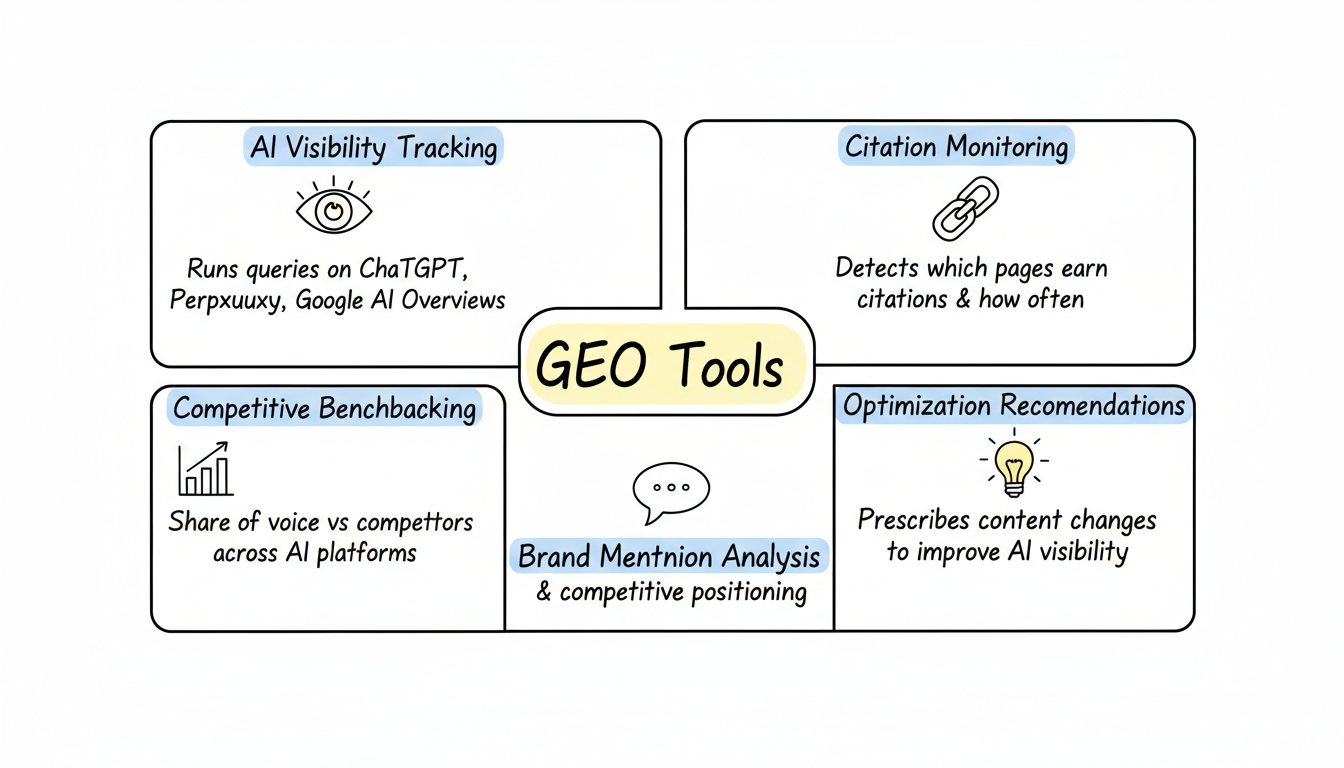
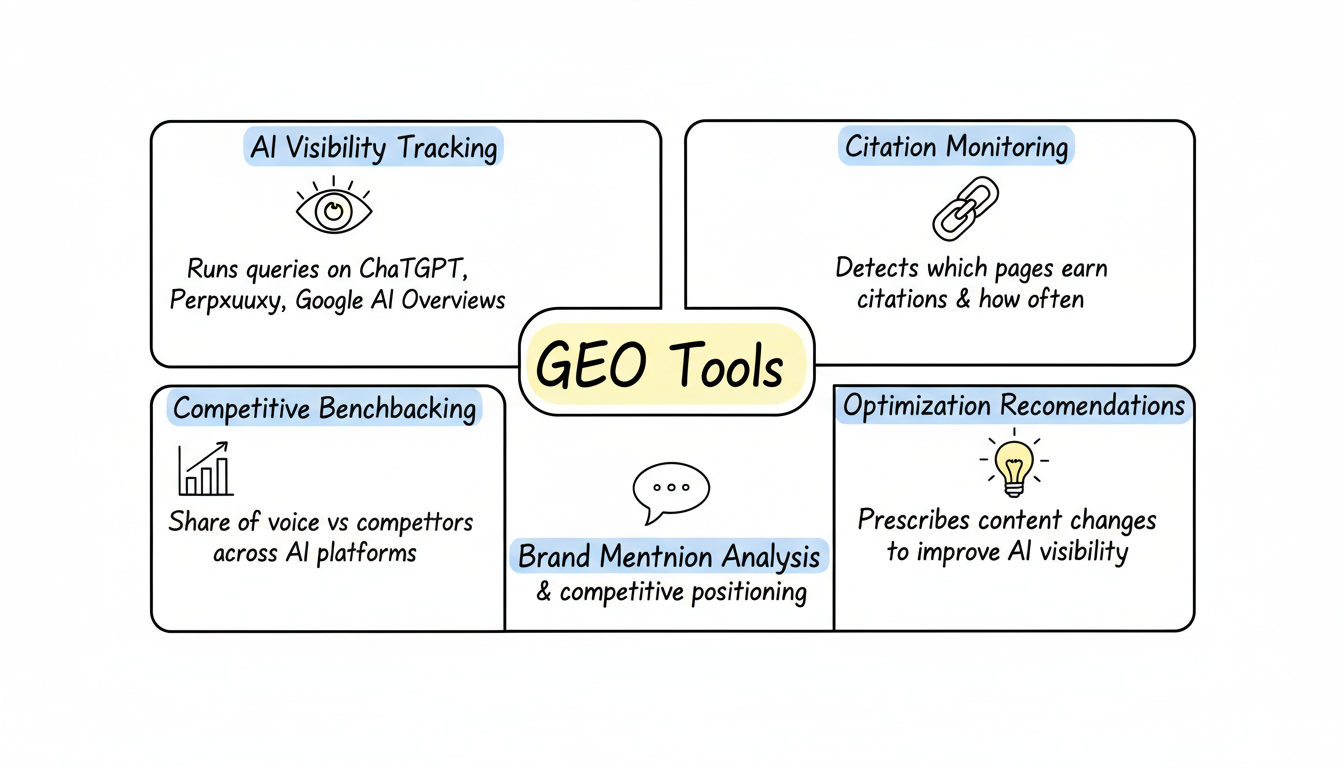
Core GEO tool functions:
GEO tools run queries on LLM platforms and record whether your brand or content appears in responses. This happens automatically at scale—tracking hundreds or thousands of relevant prompts across multiple AI platforms.
When AI platforms cite sources (Perplexity shows direct links, Google AI Overviews reference URLs), GEO tools detect which pages earn citations and how often. This reveals what content AI systems trust. Understanding Copilot citation patterns can further inform your optimization strategy.
Beyond citations, GEO tools track how AI systems describe your brand—sentiment, accuracy, positioning relative to competitors. A mention that mischaracterizes your offering may harm more than help.
Share of voice metrics show how your AI visibility compares to competitors. If ChatGPT recommends three alternatives before mentioning you, that competitive positioning matters.
Advanced platforms move beyond monitoring to prescribe actions—which content to restructure, which entity signals to strengthen, which authority gaps to fill. Many organizations benefit from reviewing AEO case studies to understand what successful implementations look like.
Best for: Enterprise teams integrating AI visibility with existing SEO workflows
Pricing: Custom enterprise pricing
Conductor extends established SEO capabilities into AI search visibility. The platform tracks brand mentions and citations across ChatGPT, Perplexity, Google AI Overviews, and Claude, integrating this data with traditional search performance.
Key features:
Where it excels: Teams already using Conductor for SEO gain AI visibility without adding another platform. The integrated approach reveals how traditional SEO and AI visibility interact—helpful for understanding the full search landscape.
Limitations: Enterprise pricing puts it beyond reach for smaller teams. Custom implementation requires meaningful setup investment. Organizations seeking more accessible options might explore affordable AEO services instead.
Best for: SEO-led teams extending existing Semrush workflows into AI search
Pricing: Pro plans start at $299/month per domain
Semrush's AI Toolkit folds GEO insights into the platform many teams already use for keyword research, competitor analysis, and rank tracking. The integration reduces tool sprawl while adding AI-specific visibility. For enterprise implementations, consider reading about Semrush AEO enterprise AIO capabilities.
Key features:
Where it excels: If your agency already uses Semrush, the AI Toolkit adds capability without operational disruption. The competitive benchmarks are particularly valuable for understanding category positioning.
Limitations: AI features are an add-on to existing Semrush plans—meaningful additional investment. Platform-specific depth may lag behind dedicated GEO tools.
Best for: Teams wanting real-time AI mention monitoring with strong backlink data context
Pricing: Included in higher-tier Ahrefs plans
Ahrefs Brand Radar provides real-time monitoring of brand mentions across AI platforms. The integration with Ahrefs' backlink database creates context—understanding which authority signals contribute to AI visibility.
Key features:
Where it excels: The connection between traditional authority metrics (backlinks, domain authority) and AI visibility provides actionable insight. Understanding what drives AI trust helps prioritize optimization efforts.
Limitations: Brand monitoring focus means less depth on content-level citation tracking. Feature set optimized for brand-level visibility over page-level performance.
Best for: SMBs, content teams, and agencies needing structured automated reports
Pricing: Starting at €89/month (approximately $95/month)
Otterly.AI provides comprehensive AI visibility tracking across ChatGPT, Google AI Overviews, Gemini, Perplexity, and Copilot. The platform combines brand monitoring, citation tracking, and GEO auditing in an accessible package.
Key features:
Where it excels: The GEO audit capability stands out—going beyond monitoring to actionable recommendations. The audit analyzes multilingual content, schema usage, and page structure, converting findings into prioritized actions.
Limitations: No native CRM or GA4 integrations—attribution requires manual assembly. Best suited for visibility monitoring rather than full-funnel attribution.
Best for: Marketing teams, SEO/AEO specialists, and agencies managing multiple brands
Pricing: Contact for pricing
Peec.ai tracks brand appearance across ChatGPT, Perplexity, Gemini, Grok, and AI Overviews. The platform focuses on prompt-level visibility tracking—understanding exactly which questions trigger your brand's appearance.
Key features:
Where it excels: The prompt-level focus helps identify specific opportunities—exact questions where you should appear but don't. Citation source identification reveals which content pieces earn AI trust. Teams looking to expand capabilities should review best AEO tools reviews for comprehensive platform comparisons.
Limitations: Like most dedicated GEO tools, no native CRM or analytics integrations. Attribution workflows require separate implementation.
Best for: Enterprise teams requiring detailed segmentation and filtering
Pricing: Contact for enterprise pricing
Scrunch AI provides multi-engine monitoring with strong segmentation capabilities. You can label prompts by buyer persona or theme, then analyze sentiment and share of voice across granular segments.
Key features:
Where it excels: The segmentation architecture allows sophisticated analysis—understanding AI visibility by audience segment, topic area, or funnel stage. Enterprise teams with complex marketing operations benefit most.
Limitations: Enterprise focus means smaller teams may find it over-complex. No self-service option—requires sales engagement. Organizations evaluating costs should compare enterprise AI search pricing across vendors.
Best for: Enterprise organizations connecting AI visibility to business impact
Pricing: Enterprise pricing (typically $3,000+/month)
BrightEdge offers real-time visibility tracking across Google AI Overviews, Perplexity, Copilot, and ChatGPT, with emphasis on connecting AI visibility to business outcomes and persona mapping.
Key features:
Where it excels: The historical context and massive dataset enable trend analysis impossible with newer platforms. Enterprise teams can track how AI visibility evolved over time and correlate changes with business metrics. For comprehensive guidance on using Google's platform, reference the Google AI Overviews official platform guide.
Limitations: Enterprise pricing and complexity make it inappropriate for smaller organizations. Implementation requires significant investment.
Best for: Teams wanting both software and professional services
Pricing: Free comprehensive tracking with service packages available
OmniSEO combines tracking technology with WebFX's professional services team. Users get both automated monitoring and expert interpretation of results.
Key features:
Where it excels: The dual-layered approach—software plus services—suits teams without internal GEO expertise. Professional interpretation helps translate visibility data into actionable strategy.
Limitations: Full value requires engaging professional services beyond the free tracking. Teams with strong internal capabilities may prefer pure software solutions. For managed services, explore enterprise AEO services options.
Best for: Teams wanting integrated traditional SEO and AI visibility in one platform
Pricing: Starting at €89/month
SE Ranking's Visible tool adds AI search tracking to their established SEO platform. Track visibility across ChatGPT, Gemini, and Perplexity alongside traditional keyword rankings.
Key features:
Where it excels: The integration of AI and traditional SEO tracking in one platform simplifies reporting and reduces tool switching. Good for teams managing both channels from a single dashboard. Understanding GEO SEO combined strategy principles enhances effectiveness.
Limitations: AI features are part of broader SEO platform—teams wanting specialized GEO depth may need supplemental tools.
Best for: Budget-conscious teams tracking AI referral traffic
Pricing: Free
GA4 can filter traffic by referral source to identify visitors from ChatGPT, Perplexity, and other AI platforms. While not a dedicated GEO tool, it provides essential baseline visibility into AI-driven traffic. Learn more about Google Analytics 4 AI search tracking implementation.
How to configure:
Where it excels: Free, already installed on most sites, provides direct traffic attribution. Essential complement to dedicated GEO tools for understanding actual business impact.
Limitations: Only tracks click-through traffic—not brand mentions or citations that don't result in visits. Requires manual configuration and doesn't show competitive data.
Different tools cover different AI platforms. Ensure your chosen tool tracks the platforms that matter for your audience:
For detailed platform analysis, review our ChatGPT vs Perplexity comparison to understand behavioral differences.
Standalone GEO tools require additional work for full attribution. If connecting AI visibility to revenue matters, prioritize tools that integrate with your analytics and CRM stack—or plan for manual attribution workflows.
Enterprise platforms with advanced segmentation create value only if your team can use those features. Smaller teams may benefit more from straightforward monitoring than sophisticated but underutilized analytics. Consider evaluating free vs paid AEO tools based on your team's capacity.
Monitoring without optimization guidance has limited value. The best GEO tools move beyond "you appear here" to "do this to improve." Evaluate whether tools provide actionable recommendations alongside visibility data.
Platform pricing plus implementation time plus ongoing management determines true cost. A $100/month tool requiring 20 hours of manual work monthly may cost more than a $500/month tool with automation.
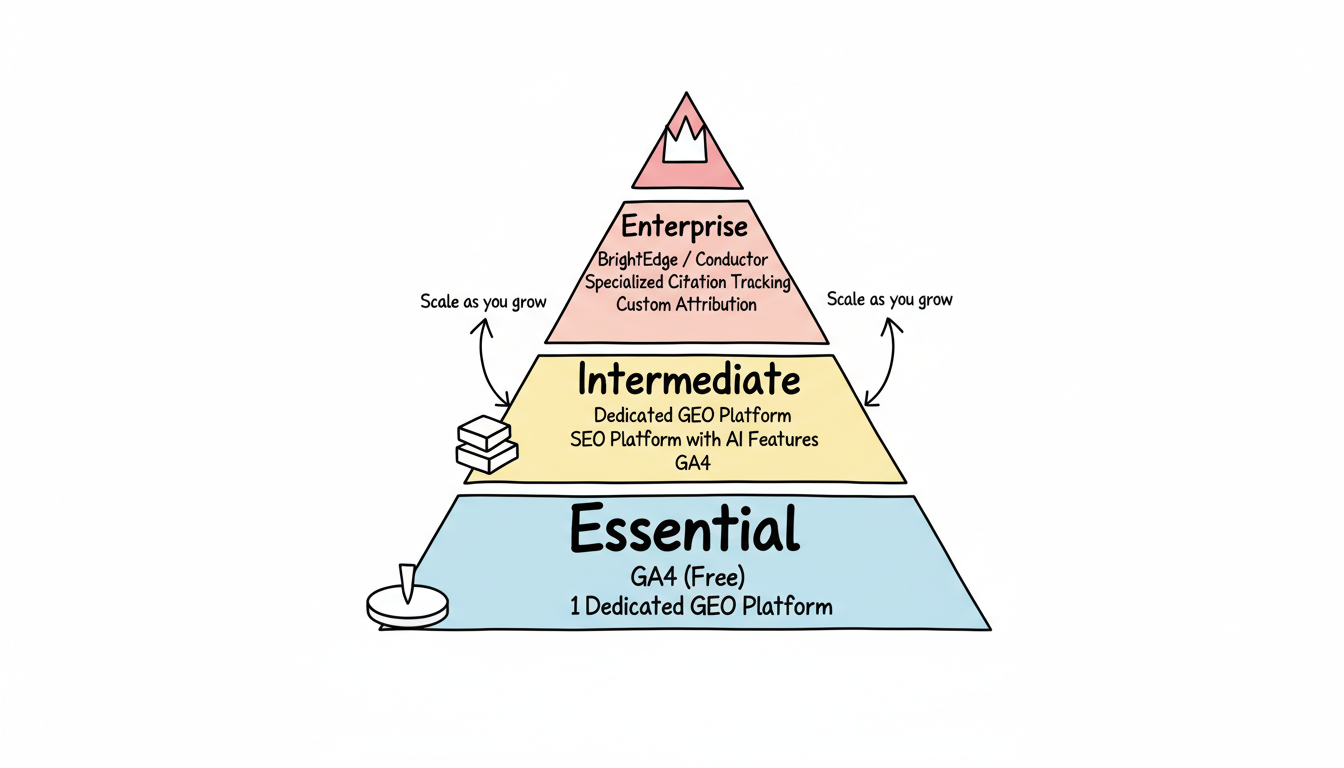
Most organizations need multiple tools for complete GEO coverage:
Essential baseline:
Intermediate stack:
Enterprise stack:
Start with your most pressing need—whether that's basic visibility monitoring, competitive benchmarking, or optimization recommendations—and expand as requirements grow. Reviewing AEO marketing examples can help clarify which capabilities drive the most value for your industry.
GEO tools generate value when insights drive action and action drives results. Track:
If you're paying for a tool but not acting on its insights, the investment isn't generating return. Tools should inform strategy, not just report status. Avoid common pitfalls by reviewing AEO marketing mistakes before implementation.
Both platforms now offer AI visibility features, which may suffice for basic monitoring. However, dedicated GEO platforms typically provide deeper analysis, more frequent updates, and better optimization recommendations. Evaluate whether your existing tools' AI features meet your needs before adding new subscriptions. For comprehensive capabilities, consider exploring best AI SEO tools that combine traditional and AI search optimization.
Most platforms update daily, though some offer real-time monitoring for brand mentions. For strategic planning, daily updates are typically sufficient. For crisis monitoring or rapid optimization, real-time capabilities matter more. Maintaining content freshness signals answer engines recognize is critical regardless of update frequency.
GA4's referral tracking provides essential traffic attribution for free. However, it can't show brand mentions, citations that don't drive clicks, competitive positioning, or optimization recommendations. Most organizations need at least one paid platform for complete visibility.
Start with platforms your audience uses most. ChatGPT has the largest user base, but Perplexity may matter more for research-oriented audiences. Google AI Overviews affect the most total searches. Prioritize based on where your customers discover information. Understanding Copilot market adoption trends can inform platform prioritization decisions.
By submitting this form, you agree to our Privacy Policy and Terms & Conditions.



