
February 19, 2026


ChatGPT now serves nearly 800 million weekly active users, making its search functionality one of the fastest-growing discovery channels in digital marketing. Understanding how ChatGPT Search selects content for citations—the ranking factors that determine visibility—has become essential for brands competing in AI-first search environments. The algorithm operates differently from traditional search engines, prioritizing different signals and rewarding different content characteristics.
According to SEOProfy's ChatGPT ranking guide, to rank well on ChatGPT, you need high-quality content that's relevant and clearly answers user questions. AI crawlers must easily access your pages, and your brand's presence needs strength through mentions on trusted sources and positive reviews online.
The citation selection process involves multiple evaluation stages before content gets referenced in responses. Understanding these stages helps inform a comprehensive aeo-strategy-framework for AI search visibility.
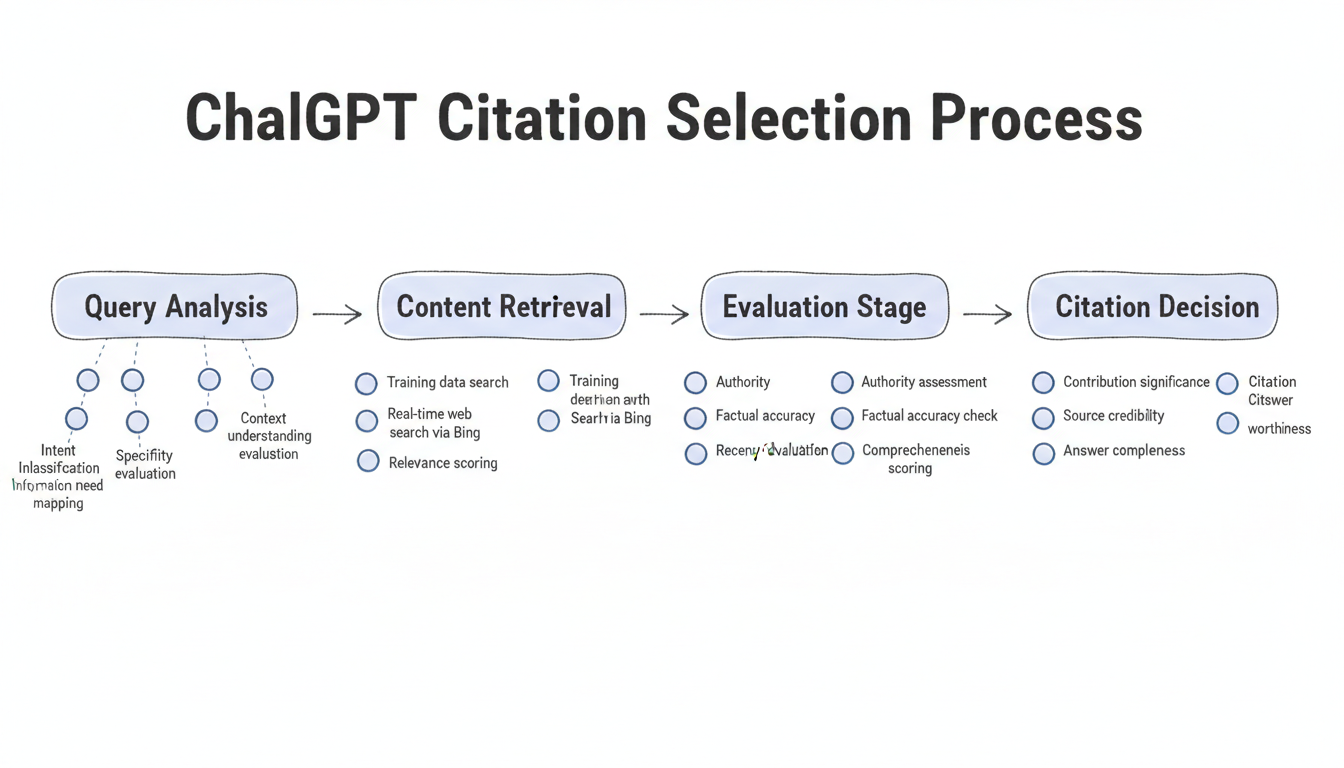
According to ALM Corp's AI search guide, when a user asks ChatGPT a question, the system follows a specific process: query understanding (analyzing intent and context), information retrieval (searching training data and performing real-time web searches), content evaluation (assessing authority, relevance, recency, and factual accuracy), synthesis (combining information from multiple sources), and citation selection (choosing sources that contributed significantly to the answer).
ChatGPT citation selection process:
ChatGPT Search Content Selection
├── Query Analysis
│   ├── Intent classification
│   ├── Context understanding
│   ├── Specificity evaluation
│   └── Information need mapping
│
├── Content Retrieval
│   ├── Training data search
│   ├── Real-time web search (via Bing)
│   ├── Source identification
│   └── Relevance scoring
│
├── Evaluation Stage
│   ├── Authority assessment
│   ├── Factual accuracy check
│   ├── Recency evaluation
│   └── Comprehensiveness scoring
│
└── Citation Decision
    ├── Contribution significance
    ├── Source credibility
    ├── Answer completeness
    └── Citation worthiness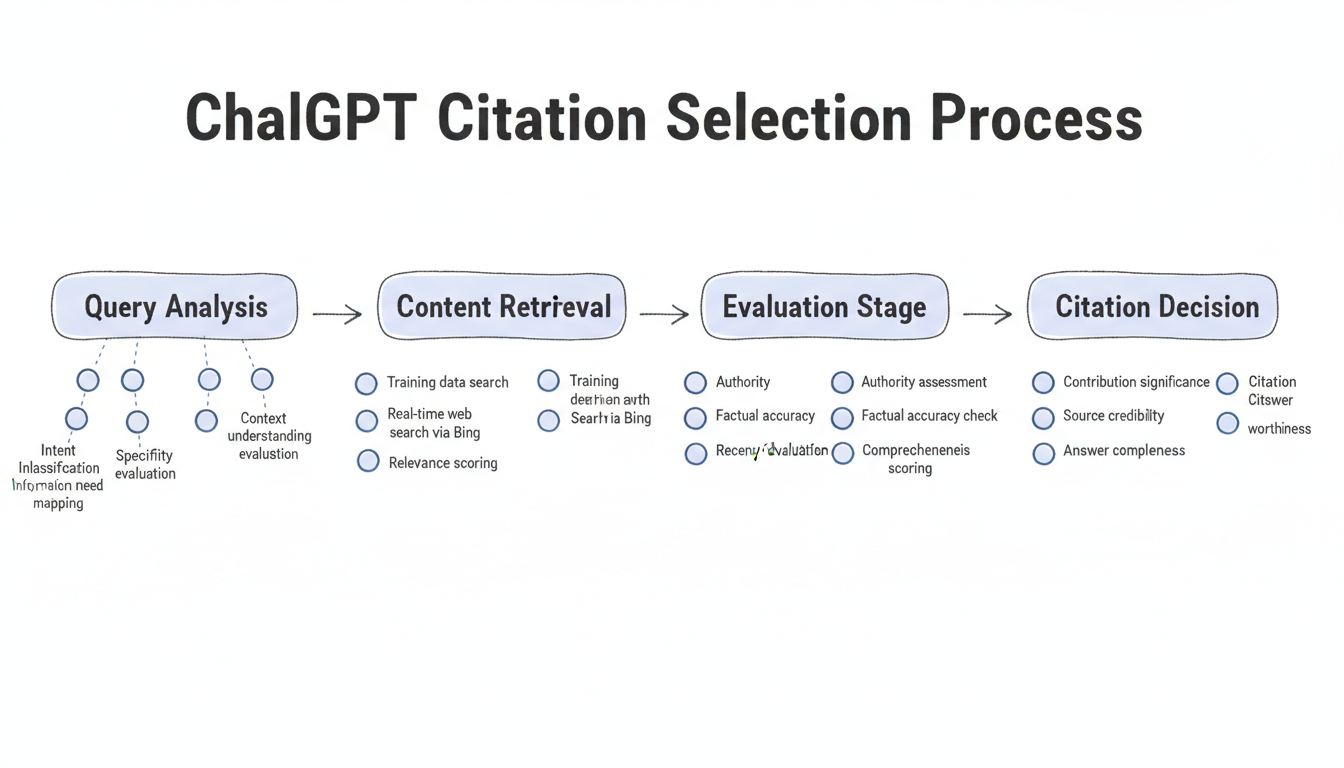
Research and practitioner analysis reveal the signals ChatGPT prioritizes when selecting citation sources. These factors differ significantly when comparing seo-vs-aeo approaches to content optimization.
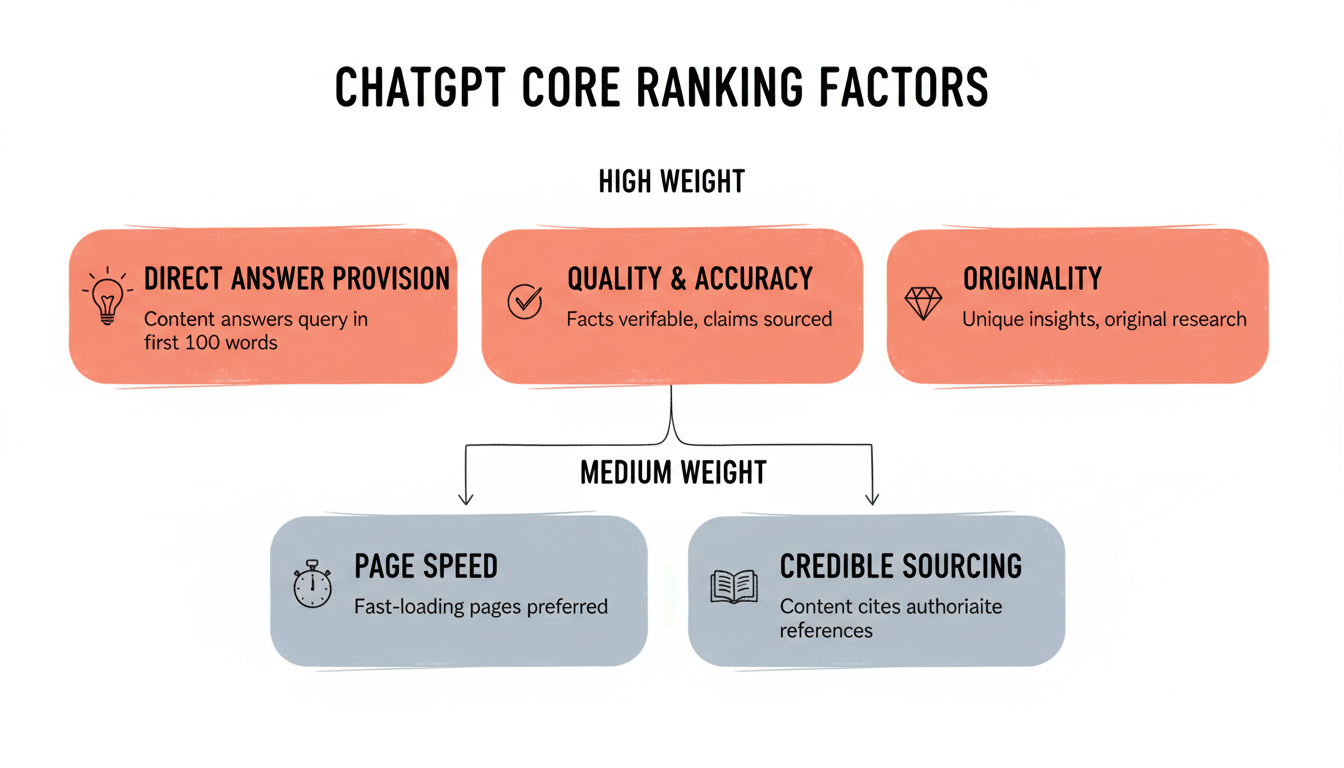
According to LinkedIn AI SEO analysis, Google's Liz Reid (VP of Search) named five core factors AI Mode looks for when ranking content: directly answers the question, is high quality and accurate, loads quickly, is original, and cites credible sources. If people click on it, value it, and come back to it, that content will rank.
Primary ranking factors:
Factor | Weight | How ChatGPT Evaluates |
Direct answer provision | High | Content answers query in first 100 words |
Quality and accuracy | High | Facts verifiable, claims sourced |
Page speed | Medium | Fast-loading pages preferred |
Originality | High | Unique insights, original research |
Credible sourcing | Medium | Content cites authoritative references |
Research confirms technical optimization impacts AI citation likelihood. Proper implementation of schema-markup-alignment-aeo represents one of the strongest technical signals for AI search systems.
According to Semrush's technical SEO AI study, analysis of 5 million cited URLs across ChatGPT Search and Google AI Mode revealed what correlates with AI visibility: structured data implementation (Organization, Article, BreadcrumbList schema appear most frequently), URL structure patterns (URLs with 17-40 character slugs receive most citations), and strong user engagement signals (higher visit duration, lower bounce rates, better conversion metrics).
Technical factors that matter:
Technical Ranking Signals
├── Structured Data
│   ├── Organization schema (highest correlation)
│   ├── Article schema (frequently cited)
│   ├── BreadcrumbList schema
│   └── FAQ schema for Q&A content
│
├── URL Structure
│   ├── 17-40 character slugs optimal
│   ├── Descriptive, keyword-rich paths
│   ├── Clean hierarchy signals
│   └── Semantic topic indicators
│
├── Crawlability
│   ├── AI crawler access enabled
│   ├── JavaScript rendering available
│   ├── Robots.txt allows AI bots
│   └── No critical content blocked
│
└── Performance
    ├── Fast page load times
    ├── Mobile responsiveness
    ├── Core Web Vitals scores
    └── Minimal render-blocking
Content characteristics determine citation worthiness beyond technical factors. Brands tracking searchgpt-algorithm-updates-changes notice that content quality requirements continue evolving as AI systems become more sophisticated.
According to ALM Corp's SEO trends analysis, AI optimization focuses on making content easily digestible and citation-worthy: use clear, literal language (avoid jargon and metaphors), structure content with descriptive headings, include factual data-backed information, implement comprehensive schema markup, create definitive authoritative resources on specific topics.
Content quality requirements:
Requirement | Implementation | Why It Matters |
Answer-first structure | Lead with direct answer | AI extracts opening content |
Clear language | Avoid jargon, metaphors | Improves AI parsing |
Descriptive headings | Topic-indicative H2/H3s | Enables section extraction |
Data-backed claims | Statistics with sources | Builds trust signals |
Comprehensive coverage | Topic depth | Establishes authority |
AI systems increasingly prioritize content that adds new information to the conversation. This concept aligns with broader generative-ai-seo-optimization strategies that focus on differentiation.
According to Medium's dual-target strategy analysis, one of the most critical metrics in 2026 SEO is "Information Gain." In a sea of AI-generated content where millions of articles regurgitate the same basic information, algorithms desperately seek something new. If your article says exactly what the top 10 ranking articles say, you offer zero Information Gain—the AI has no reason to cite you.
Information gain strategies:
Understanding how different ai-powered-search-features evaluate originality helps inform content differentiation strategies across multiple AI platforms.
ChatGPT evaluates brand credibility when selecting citation sources. Building entity authority often requires consultation with an aeo-expert who understands how AI systems assess brand signals.
According to SEOProfy's LLM SEO guide, language models prefer content that brings something new because they've been trained on huge amounts of existing material. Shallow AI content may fail because the AI already knows generic information—original data and insights differentiate citation-worthy content.
Brand authority signals:
Signal | How to Build | Impact |
Third-party mentions | PR, guest posts, interviews | High |
Expert authorship | Bylines with credentials | Medium-High |
Review presence | G2, Trustpilot, industry directories | Medium |
Wikipedia references | Cited in relevant articles | High |
Consistent entity data | Same info across platforms | Medium |
Engagement signals indicate content value to both users and AI systems. These metrics become even more critical when implementing aeo-marketing-conversion-strategies that depend on user behavior signals.
According to Semrush's study, top-cited pages demonstrate higher visit duration, lower bounce rates, and better conversion metrics across all traffic sources. User engagement correlates strongly with AI citation frequency.
Engagement metrics that matter:
User Engagement Signals
├── Visit Duration
│   ├── Longer time on page = quality indicator
│   ├── Correlates with content depth
│   └── Measured across all traffic sources
│
├── Bounce Rate
│   ├── Lower = better AI citation potential
│   ├── Indicates query satisfaction
│   └── Page meets user expectations
│
├── Return Visits
│   ├── Users bookmark and revisit
│   ├── Strong trust indicator
│   └── Shows ongoing value
│
└── Conversion Actions
    ├── Newsletter signups
    ├── Resource downloads
    └── Further engagement
Tracking visibility requires AI-specific monitoring approaches. Many businesses leverage best-aeo-tools-reviews to automate this monitoring process across multiple AI search platforms.
According to SE Visible's AI tracking guide, in AI results, positions can flip multiple times in a single day—staying visible means constant monitoring and fast tweaks. Start with a manual baseline: ask chatbots about your niche and note whether they cite you, which page they pull, and how they describe you.
Monitoring approaches:
Method | What It Tracks | Frequency |
Manual queries | Citation presence | Weekly |
AI visibility tools | Mention frequency | Daily |
Competitor comparison | Share of voice | Weekly |
Sentiment analysis | How brand is described | Monthly |
Businesses should also implement schema-validation-and-testing-for-ai-search processes to ensure technical implementations remain effective as ranking factors evolve.
ChatGPT Search ranking factors combine technical, content, and authority signals:
According to Search Engine Journal's enterprise trends, while AI and new technologies reshape search, fundamental technical principles remain crucial. The shift is from basic keyword matching to prioritizing user intent and delivering conversational, synthesized responses—with citations going to content that best serves those conversations. Implementing the best-generative-engine-optimization-strategy requires understanding these ranking factors and adapting content accordingly.
By submitting this form, you agree to our Privacy Policy and Terms & Conditions.



