February 19, 2026


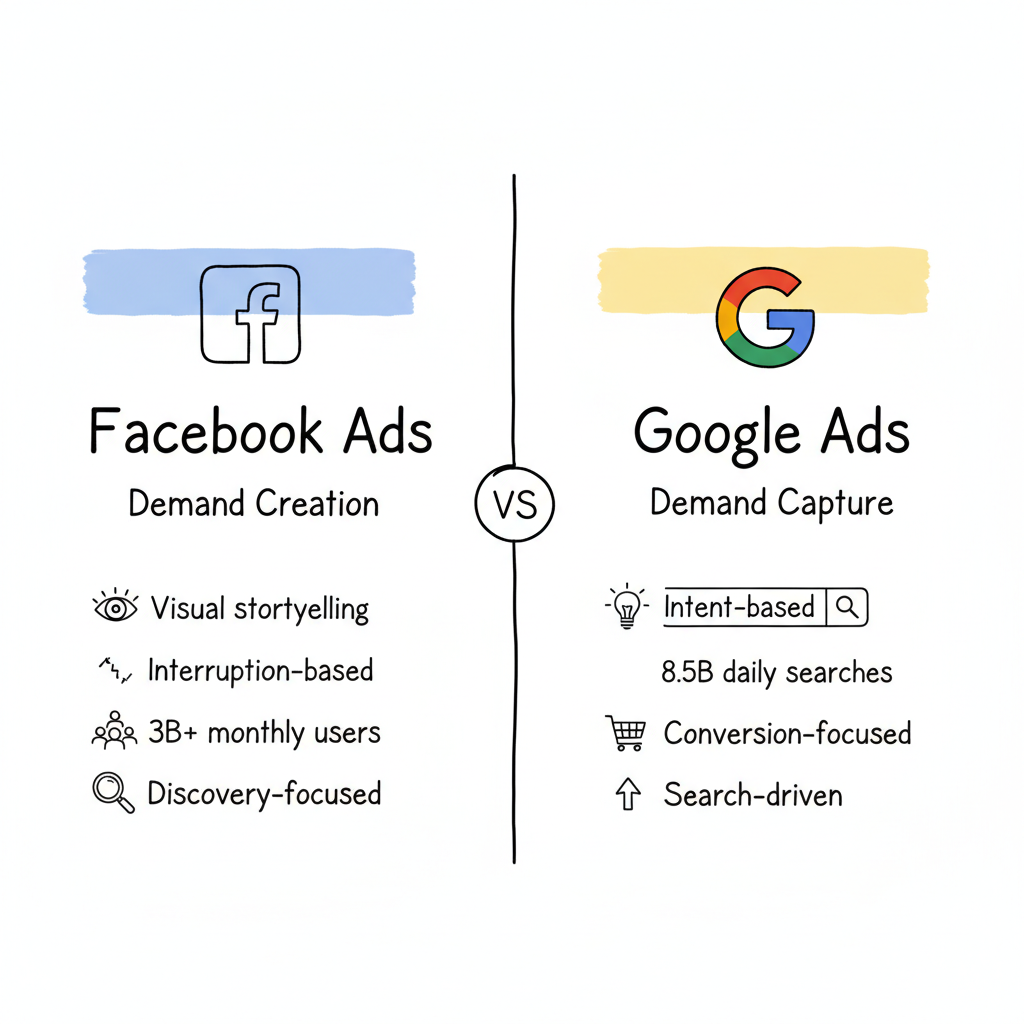
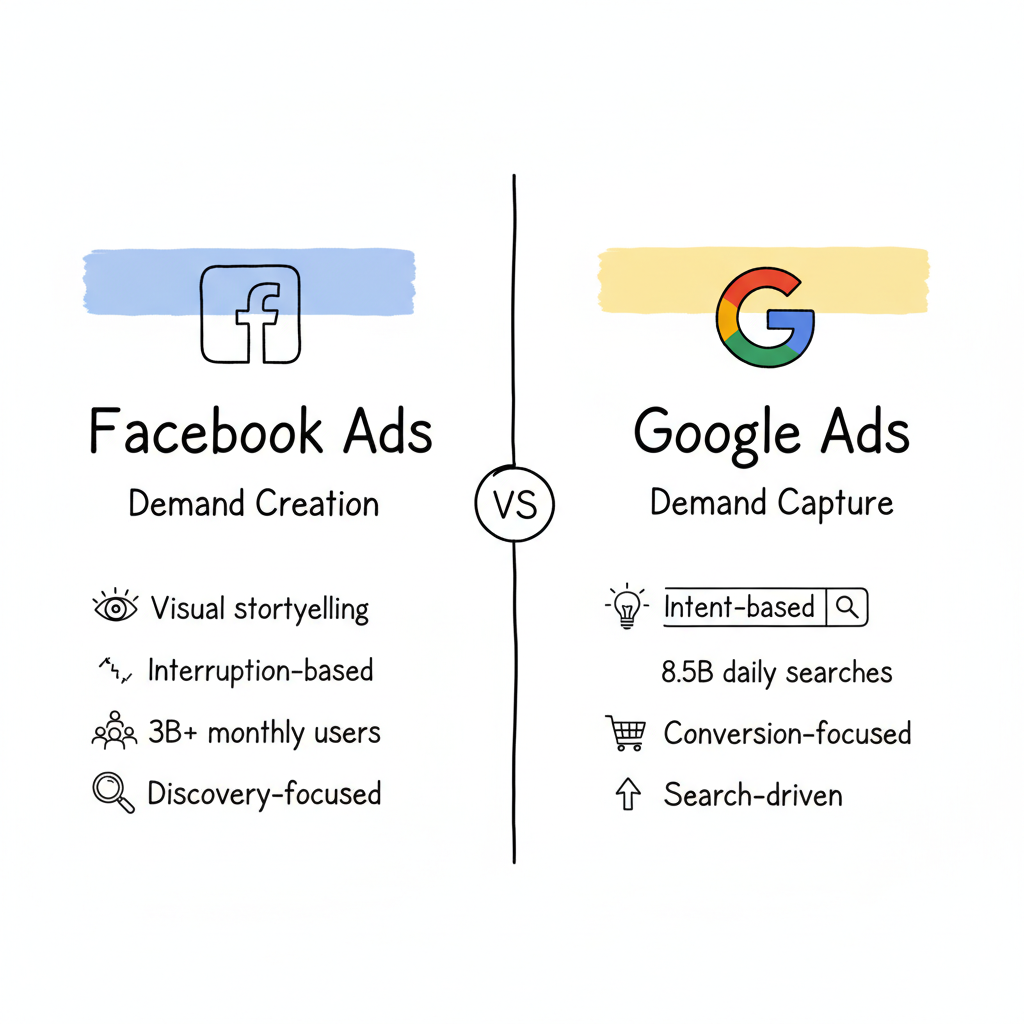
Choosing between Facebook Ads and Google Ads is one of the most important decisions advertisers face in 2026. Both platforms offer powerful advertising capabilities, but they serve fundamentally different purposes in the customer journey. Facebook Ads excels at creating demand through visual storytelling and precise demographic targeting, while Google Ads captures existing demand from users actively searching for solutions.
This comprehensive comparison breaks down everything you need to know about Facebook Ads vs Google Ads—from costs and targeting capabilities to ad formats and best use cases—so you can make an informed decision for your business.
Understanding the core differences between these advertising giants is essential before diving into specific comparisons.
Facebook Ads, now officially part of what are meta ads ecosystem, allows advertisers to reach users across Facebook, Instagram, Messenger, and the Audience Network. The platform's strength lies in its 3 billion+ monthly active users and the extensive demographic, behavioral, and interest-based data it collects.
Key characteristics of Facebook Ads include:
Google Ads operates across Search, Display Network (35+ million websites), YouTube, and Shopping. The platform captures users at the moment of intent—when they're actively searching for products, services, or information.
Key characteristics of Google Ads include:
One of the biggest factors in the Facebook Ads vs Google Ads debate is cost. Understanding the average cost of facebook ads can help you budget effectively. Here's how the platforms compare in 2026:
Platform | Average CPC | Typical Range |
Facebook Ads | $0.62 | $0.51 - $1.50 |
Instagram Ads | $1.17 | $0.70 - $2.00 |
Google Search Ads | $2.69 | $1.00 - $50+ |
Google Display Network | $0.63 | $0.30 - $1.00 |
Platform | Average CPM | Notes |
Facebook Ads | $11.62 | US market averages $17-23 |
Instagram Ads | $12.19 | Slightly higher than Facebook |
Google Display Network | $3.12 | Lowest CPM option |
YouTube Ads | $4-$10 | Varies by ad format |
Both platforms see significant cost variations by industry. If you're wondering how much to run ads on facebook for your specific sector, these benchmarks provide helpful guidance:
Facebook Ads CPC by Industry:
Google Ads CPC by Industry (USD):
The bottom line: Facebook Ads typically offers lower CPCs across most industries, but Google Ads users often have higher purchase intent, which can lead to better conversion rates and ROAS despite higher costs.
Both platforms offer sophisticated targeting, but their approaches differ significantly. Mastering facebook ads targeting is crucial for campaign success.
Facebook's targeting leverages the extensive personal data users share on the platform. According to advertising experts, Facebook's targeting capabilities remain one of its significant advantages in 2026.
Core targeting options include:
Key strength: The Lookalike Audience feature is particularly powerful for finding users with characteristics similar to your existing customers.
Limitation: iOS 14.5 privacy changes have reduced some tracking capabilities, making first-party data more important than ever.
Google Ads targeting is built around user intent and contextual relevance:
Search Ads targeting:
Display Network targeting:
Key strength: Intent-based targeting means you're reaching people actively searching for what you offer, leading to higher conversion rates for high-intent keywords.
Limitation: Less granular demographic data compared to Facebook.
The platforms offer distinctly different creative options. Developing a strong meta ads creative strategy is essential for maximizing engagement and conversions.
Meta's ecosystem supports highly visual, engaging ad formats:
Best for: Brands with strong visual assets, products that benefit from lifestyle imagery, and advertisers who want creative flexibility.
Google offers formats optimized for different campaign objectives:
Search Ads:
Display & Video:
Best for: Direct response campaigns, capturing high-intent traffic, and product-specific advertising.
Understanding when to use each platform is crucial for maximizing your advertising ROI. Many businesses choose to work with a facebook ads marketing agency to navigate these strategic decisions.
Facebook Ads works best when you need to:
Industries that thrive on Facebook Ads:
Google Ads excels when you need to:
Industries that thrive on Google Ads:
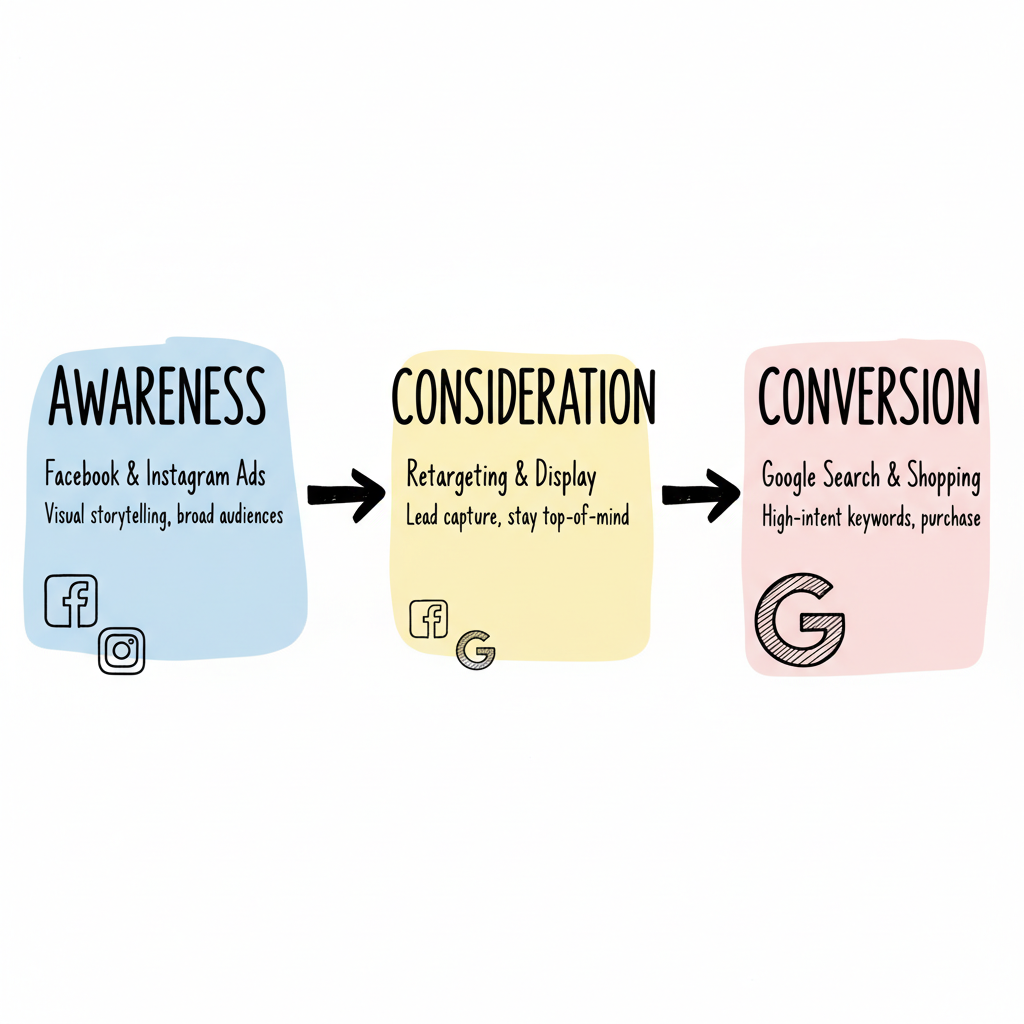
The most successful advertisers in 2026 don't choose between Facebook Ads and Google Ads—they use both strategically. For e-commerce businesses specifically, understanding google ads vs facebook ads ecommerce dynamics is particularly important. According to industry experts, combining the platforms creates a powerful full-funnel approach.
Here's how to integrate both platforms. If you're learning how to use meta ads instagram as part of your social strategy, it integrates seamlessly with this approach:
Top of Funnel (Awareness):
Middle of Funnel (Consideration):
Bottom of Funnel (Conversion):
A common starting framework for using both platforms. Use a facebook ads cost calculator to estimate your investment across channels:
Business Type | Facebook Ads | Google Ads |
E-commerce (new brand) | 60% | 40% |
E-commerce (established) | 40% | 60% |
Local services | 30% | 70% |
B2B SaaS | 40% | 60% |
D2C consumer goods | 70% | 30% |
Adjust based on performance data and your specific customer journey. Understanding what is good roi facebook ads benchmarks helps you evaluate performance objectively.
Facebook Ads typically has a lower average CPC ($0.62) compared to Google Search Ads ($2.69). However, "cheaper" doesn't always mean "better value." Google Ads users often have higher purchase intent, which can result in better conversion rates despite higher costs. The most cost-effective platform depends on your specific goals, industry, and target audience. Calculating facebook ads cost per day helps with budgeting decisions.
Facebook Ads is generally considered more beginner-friendly due to its intuitive interface and lower minimum budgets. You can start testing with as little as $5/day. Google Ads has a steeper learning curve, particularly for keyword research and bid management, but offers extensive documentation and certifications for those willing to learn. For businesses new to either platform, learning how to run facebook ads for clients or working with a facebook ads management agency can accelerate results.
Absolutely—and many successful advertisers do exactly that. Running campaigns on both platforms allows you to capture users at different stages of the buying journey. Use Facebook to build awareness and Google to capture high-intent searches. Just ensure you have proper tracking (Meta Pixel and Google Analytics) to measure cross-platform performance.
ROI varies significantly by industry, product, and campaign execution. According to industry benchmarks, Facebook Ads typically delivers 1.5x to 4x ROAS for e-commerce, while Google Ads can deliver higher immediate conversion rates for high-intent searches. Use a facebook ads roi calculator to project returns, and measure average roi facebook ads against your actual performance. The best approach is to test both platforms and measure results for your specific business.
iOS 14.5 and increasing privacy regulations have impacted both platforms, but Facebook Ads has been more significantly affected due to its reliance on cross-app tracking. Google Ads, particularly Search campaigns, remains relatively unaffected since it's based on first-party search data. Both platforms are adapting with enhanced conversion tracking and modeled results.
By submitting this form, you agree to our Privacy Policy and Terms & Conditions.