February 19, 2026


Generative AI has fundamentally changed how SEO works. From content creation to keyword research to optimization, AI tools now participate in nearly every aspect of search marketing. But understanding how to use generative AI effectively—without undermining your rankings or credibility—requires navigating a rapidly evolving landscape.
This guide covers what generative AI SEO means, how it changes your workflows, and the best practices that separate successful implementations from costly mistakes.
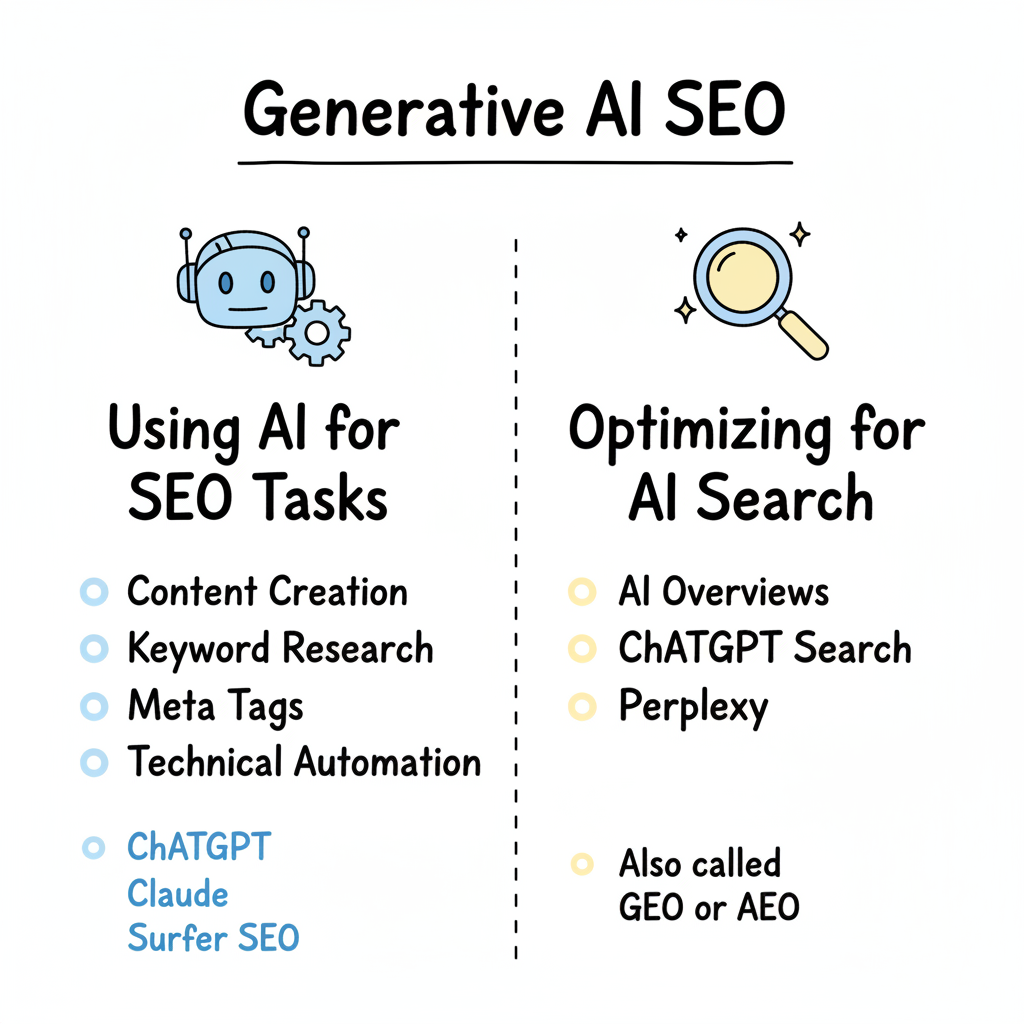
Generative AI SEO encompasses two distinct but related practices:
Using generative AI for SEO tasks: Leveraging AI tools like ChatGPT, Claude, or specialized SEO platforms to assist with content creation, keyword research, optimization, and analysis. This includes generating drafts, creating outlines, writing meta descriptions, and automating repetitive tasks.
Optimizing for generative AI search: Structuring content so it gets discovered, understood, and cited by AI-powered search experiences like ChatGPT Search, Perplexity, and Google AI Overviews. This is also known as generative engine optimization or AEO (Answer Engine Optimization).
Both practices matter in 2026. The first helps you work more efficiently. The second ensures your content remains visible as search behavior shifts toward AI-powered discovery.
The integration of generative AI has transformed SEO workflows across multiple dimensions.
AI tools now assist at every stage of content production:
Studies show AI-assisted content performs nearly identically to human-written content in search rankings—when quality controls remain in place. The differentiator isn't whether AI was involved, but whether the final output demonstrates expertise and value. Understanding search engine optimization with AI helps teams maintain quality while increasing efficiency.
Generative AI has accelerated keyword research from hours to minutes:
AI-powered tools now handle technical tasks that previously required significant manual effort:
For those implementing structured data, schema markup validators for AEO ensure your markup meets AI extraction requirements.
Perhaps the biggest change: generative AI now is the search experience for millions of users. AI Overviews appear at the top of Google results. ChatGPT answers questions directly. Perplexity synthesizes information from multiple sources.
This shift means optimizing for traditional rankings is no longer sufficient. Content must also be structured for AI extraction and citation. Many marketers are discovering that GEO is the new SEO as these AI-powered experiences reshape search behavior.
The most immediate application of generative AI in SEO is content production. Here's how to use it effectively.
Generative AI excels at specific content tasks:
Effective AI content optimization leverages these strengths while maintaining human oversight.
AI struggles with tasks requiring lived experience:
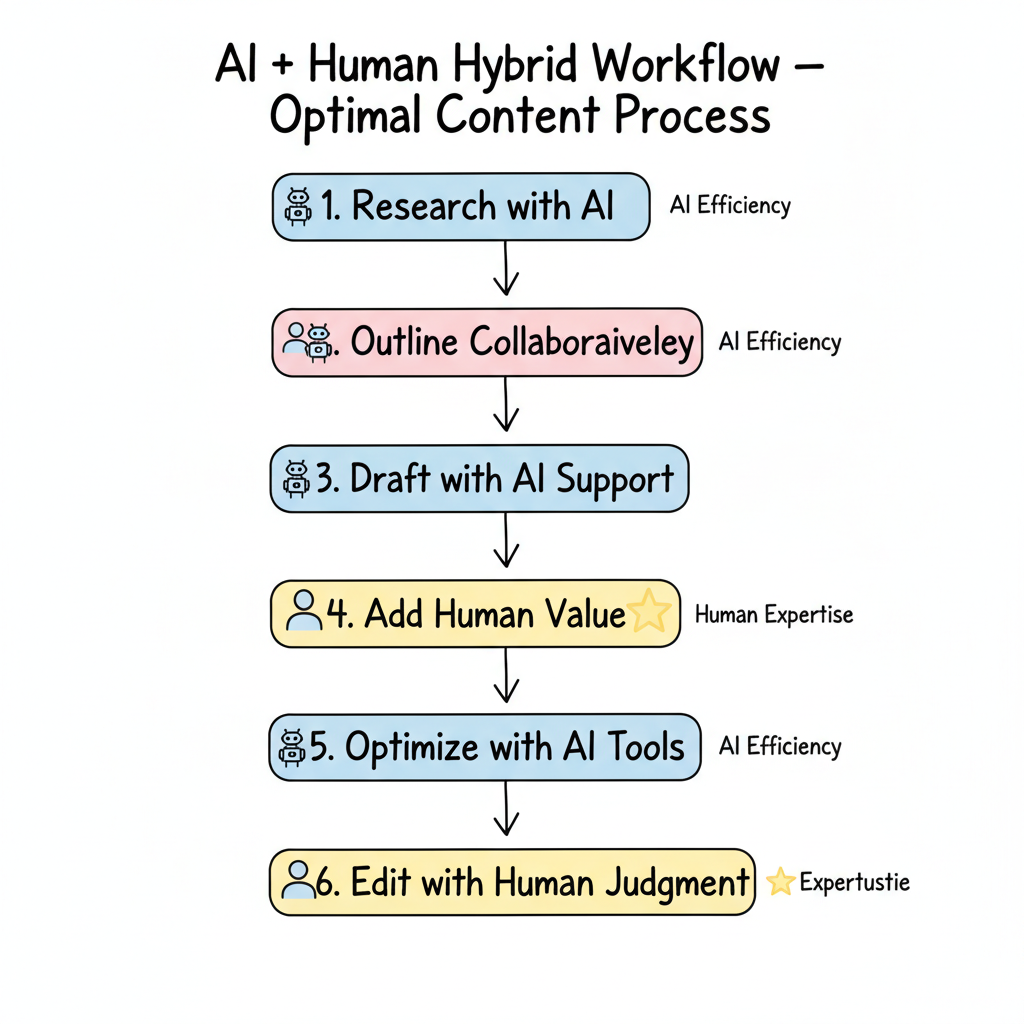
The most effective approach combines AI efficiency with human expertise:
This workflow uses AI to eliminate busywork while preserving what makes content valuable: human expertise and authentic perspective.
Several categories of tools apply generative AI to SEO tasks.
Semrush includes AI-powered features across its suite—from content optimization to competitive analysis to automated recommendations. Its ContentShake AI generates SEO-ready content based on keyword research.
SE Ranking offers AI content scoring and optimization recommendations at lower price points than enterprise platforms. For budget-conscious teams, exploring AI SEO software by budget reveals options across different price ranges.
Surfer SEO uses NLP to analyze top-ranking content and provide real-time optimization scoring. Its AI writing assistant generates content based on SERP analysis.
Clearscope applies AI to content grading and topic coverage analysis, helping teams ensure comprehensive coverage.
Frase automates SERP research compilation and brief generation, accelerating the pre-writing process. Our Frase.io review details its strengths and limitations for different use cases.
ChatGPT and Claude serve as versatile assistants for drafting, outlining, editing, and ideation. Both require human oversight but dramatically accelerate production.
Jasper offers marketing-specific templates and brand voice training for consistent AI-assisted content.
Alli AI automates technical SEO implementation at scale, using AI to optimize meta tags, internal links, and other elements without manual intervention.
Understanding both sides helps you navigate generative AI SEO successfully.
Increased productivity: Teams produce more content without proportional increases in resources. Tasks that took hours now take minutes.
Consistent optimization: AI tools apply optimization systematically, catching opportunities human review might miss.
Scalable operations: Small teams can compete with larger organizations by automating routine work.
Faster iteration: AI enables rapid testing and refinement of content approaches.
Reduced costs: While tools have costs, the efficiency gains often exceed the investment.
Quality degradation: AI content without human oversight tends toward generic outputs that fail to differentiate.
Accuracy issues: AI models hallucinate—generating plausible but false information. Without fact-checking, this erodes credibility.
Homogenization: When everyone uses similar AI tools with similar prompts, content converges toward sameness.
Detection and perception: While Google doesn't penalize AI content, audiences may perceive mass-produced AI content negatively.
Over-reliance: Teams that outsource thinking to AI lose the expertise that differentiates their content.
Velocity signals: Sudden spikes in publishing volume can trigger algorithmic scrutiny.
Google's position has been consistent and clear: content quality matters regardless of how it's created.
Google's John Mueller stated in late 2025: "Our systems don't care if content is created by AI or humans. What matters is whether it's helpful for users."
This means:
Understanding the practical differences in what is AEO vs SEO helps clarify how quality standards apply across traditional and AI-powered search.
The December 2025 core update refined how Google assesses content quality:
Google's E-E-A-T framework (Experience, Expertise, Authoritativeness, Trustworthiness) now applies broadly—not just to health and finance content. The December 2025 update extended these requirements to competitive searches across all categories.
For AI-assisted content, this means:
Follow these guidelines to use generative AI effectively without undermining your SEO performance.
Never publish AI content without human review. Check facts, verify sources, and ensure accuracy. AI models confidently generate false information—your reputation depends on catching errors.
Every piece of content should include something AI couldn't generate:
Building a comprehensive generative engine content strategy ensures your content provides genuine value that AI alone cannot replicate.
Don't let AI homogenize your brand. Train AI tools on your style guidelines. Edit outputs to match your authentic voice. Readers—and increasingly, AI systems—value distinctive perspectives.
While Google doesn't require AI disclosure, transparency builds trust. Consider adding notes like "Written with AI assistance" or "Research compiled using AI tools" where appropriate.
The ultimate test: does your content genuinely help users? AI-assisted content that solves problems, answers questions completely, and provides actionable value will rank regardless of its creation method. Implementing featured snippet optimization with AI ensures your answers surface in both traditional and AI-powered results.
AI enables higher volume, but quality remains paramount. One excellent article outranks ten mediocre ones. Use AI to work smarter, not just faster.
Track how AI-assisted content performs versus fully human-written content. Let data guide your approach rather than assumptions about what works. Understanding AEO conversion rates helps measure the business impact of AI-optimized content.
No. Google evaluates content based on quality, helpfulness, and expertise—not creation method. However, low-quality AI content that lacks expertise, originality, or value will struggle to rank, just as low-quality human content does.
Technically yes, but practically no. Content that relies entirely on AI without human expertise, fact-checking, and value-addition tends to underperform. The most successful approaches use AI as an assistant while maintaining human oversight and input.
Add what AI cannot: original insights, first-hand experience, unique data, and authentic expertise. Use AI to accelerate production and optimize structure, but ensure the final content demonstrates real value beyond what anyone could generate with the same prompt.
Detection tools exist but aren't perfectly accurate. More importantly, Google focuses on content quality rather than detection. Content that reads as generic, lacks expertise, or provides no unique value will struggle—whether AI-detected or not.
While not required, transparency builds trust. Many organizations add notes about AI assistance without negative impact. The key is ensuring AI-assisted content meets the same quality standards as any other content.
By submitting this form, you agree to our Privacy Policy and Terms & Conditions.