
February 19, 2026


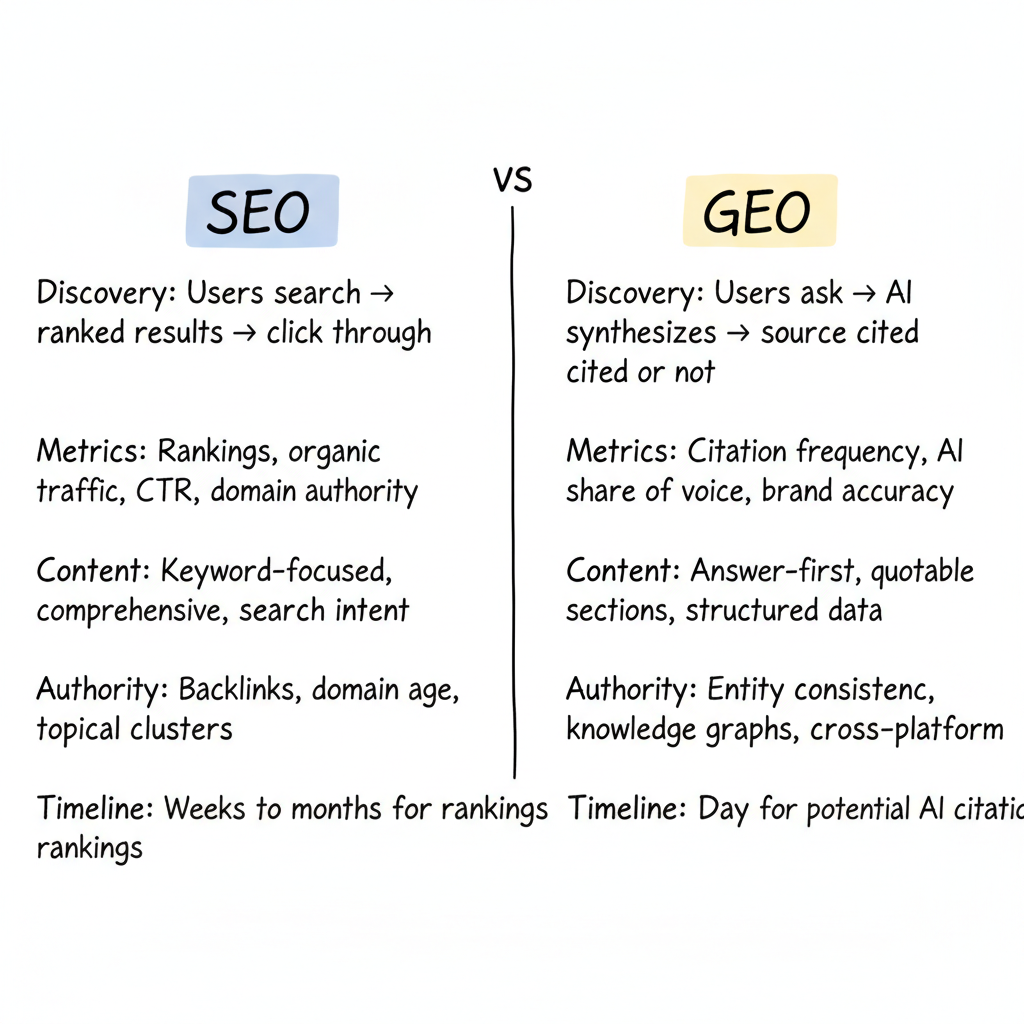
The question isn't whether to choose GEO or SEO—it's how to make them work together. Google AI Mode now reaches over 2 billion monthly users across 200+ countries. Traditional search still processes billions of queries daily. Brands optimizing for only one channel miss half their potential audience.
GEO (Generative Engine Optimization) and SEO (Search Engine Optimization) serve different but complementary purposes. Understanding their differences—and integration points—determines whether your content strategy captures the full spectrum of search visibility in 2026.
SEO is the practice of optimizing content to rank higher in traditional search engine results pages (SERPs). For over two decades, SEO has been the foundation of organic digital visibility.
Core SEO objectives:
SEO operates on a ranking paradigm. Search engines evaluate pages against competitors and display results in order of perceived relevance and quality. Position matters enormously—the top three organic results capture over 50% of clicks.
What SEO rewards:
SEO has evolved significantly, but the fundamental model remains: create valuable content, optimize it for discovery, and earn your place in search rankings through demonstrated quality.
GEO is the practice of structuring content so AI platforms can accurately interpret, reference, and cite it in generated responses. Unlike SEO's ranking paradigm, GEO operates on a citation paradigm.
Core GEO objectives:
GEO recognizes that AI platforms don't rank documents—they synthesize information to answer questions. Your content either gets included in that synthesis or it doesn't. There's no "position 7" in an AI-generated response.
What GEO rewards:
Research from Princeton and Georgia Tech found that generative engine optimization methods can boost AI visibility by 30-40%, with some tactics showing 115% improvement for lower-ranking sites. The strategies that work for AI citations often differ from traditional SEO optimization.
Understanding the fundamental differences helps you optimize effectively for each channel.
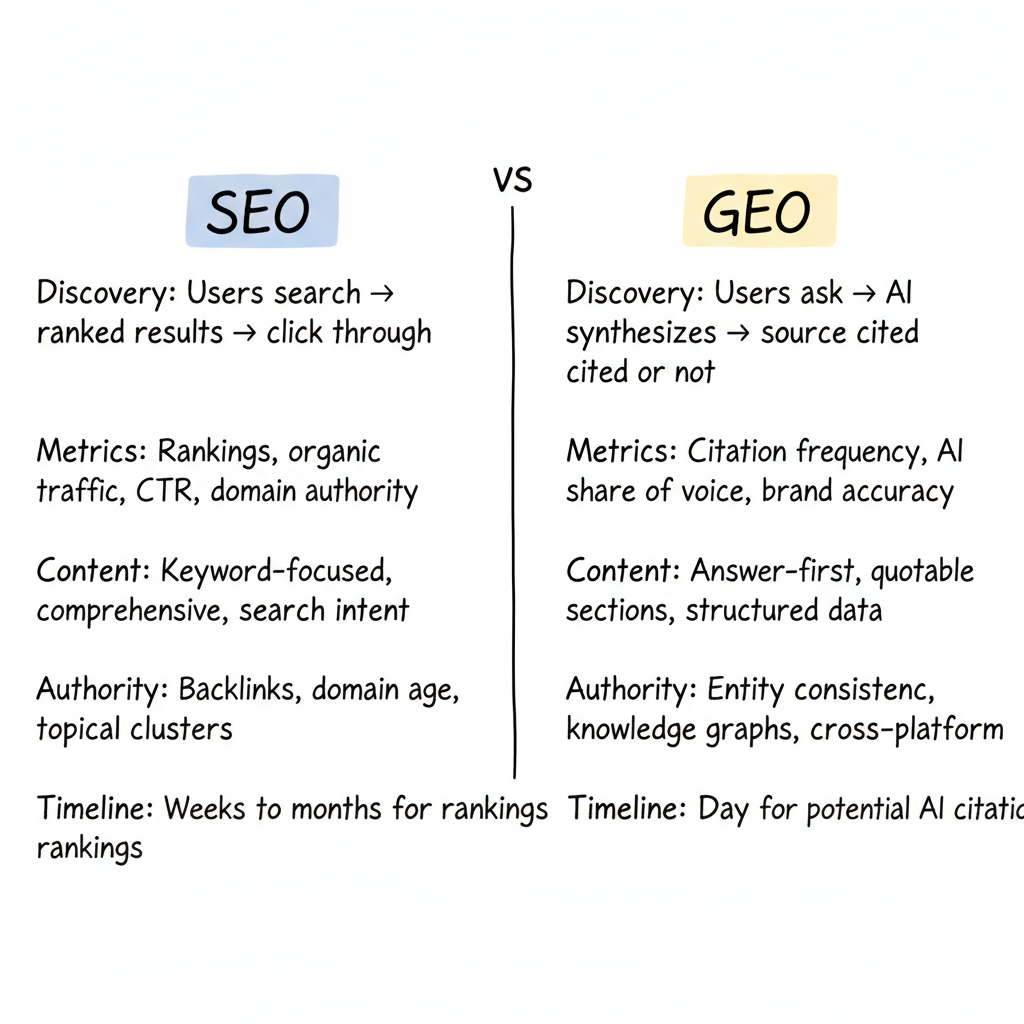
SEO: Users type queries → Search engines return ranked results → Users click through to websites
GEO: Users ask questions → AI synthesizes answers from multiple sources → Users may or may not see original sources
In traditional search, ranking determines visibility. In AI search, citation determines visibility. A page can rank #15 on Google yet be prominently cited by ChatGPT—or rank #1 and never appear in AI responses.
SEO success metrics:
GEO success metrics:
These metrics require different tracking approaches. Traditional SEO tools don't measure AI citations. New monitoring solutions like SearchGPT citation tracking specifically track AI visibility across platforms.
What SEO-optimized content looks like:
What GEO-optimized content looks like:
The best content satisfies both requirements, but the emphasis differs. SEO content must first be found; GEO content must first be quotable.
How SEO evaluates authority:
How GEO evaluates authority:
AI systems verify authority differently than search engines. They cross-reference your brand identity across multiple sources, looking for consistency and external validation rather than just link graphs. Building SEO knowledge graph implementation becomes essential for both channels.
SEO timeline:
GEO timeline:
AI platforms can discover and cite new content much faster than traditional search engines rank it. This creates opportunities for newer brands to establish AI presence while building traditional SEO authority.
Neither GEO nor SEO alone captures the full search landscape. Here's why integration matters.
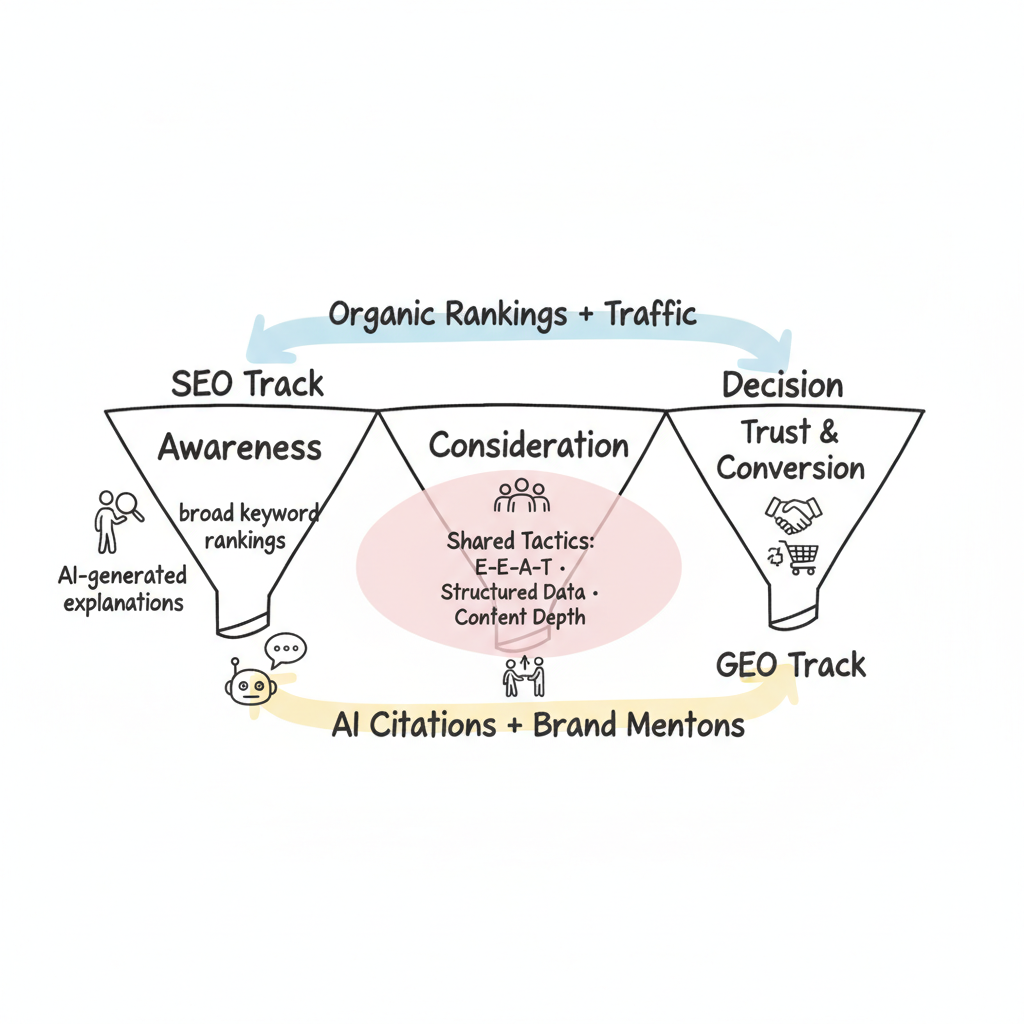
Top of funnel (Awareness): SEO drives discovery through broad keyword rankings. Users searching "what is marketing automation" find your educational content through traditional search.
Middle of funnel (Consideration): GEO places your brand in AI-generated explanations. When users ask ChatGPT to compare solutions, your brand appears in the synthesized answer.
Bottom of funnel (Decision): Both channels reinforce trust. Users verify AI recommendations through traditional search, and search results reference the same authority signals AI systems used.
Brands visible in both channels appear more credible than those visible in only one. When AI cites you AND you rank well, users trust you more.
Many tactics benefit both channels simultaneously:
Content depth: Comprehensive content ranks better in traditional search AND provides more material for AI citation.
E-E-A-T signals: Author expertise helps Google rankings AND AI source evaluation.
Structured data: Schema markup improves rich snippets AND helps AI systems parse your content. Implementing FAQ schema for AI overviews serves both traditional and AI search.
Factual accuracy: Accurate content earns user trust in search AND AI verification.
Internal linking: Topic clusters improve SEO authority AND help AI understand your expertise scope.
The overlap means you're not building two separate strategies—you're building one comprehensive strategy with channel-specific optimizations. Understanding what is AEO in marketing helps frame this integrated approach.
Search behavior is shifting rapidly. Over 45% of searches now end without clicks. AI platforms are capturing query volume that would have gone to traditional search.
Brands optimizing only for SEO risk:
Brands optimizing only for GEO risk:
Integrated strategies hedge against both risks while capturing opportunities in both channels.
Here's how to optimize for both GEO and SEO effectively.
Build content that serves both channels:
Pillar pages: Comprehensive resources that rank for broad terms and provide extensive material for AI citation.
Cluster content: Specific topic coverage that captures long-tail search traffic and answers focused AI queries. Strategic use of long-tail keywords for featured snippet success enhances visibility.
FAQ sections: Question-answer formats that target featured snippets AND match conversational AI query patterns.
Resource pages: Data-rich content with statistics and citations that earns backlinks AND provides quotable facts for AI.
Implement technical elements that benefit both channels:
Develop authority signals that work across channels:
For SEO:
For GEO:
For both:
Optimize individual content pieces for dual visibility:
Track performance across both channels:
Weekly monitoring:
Monthly analysis:
Quarterly review:
Using Google Search Console for AEO alongside traditional metrics provides comprehensive visibility tracking. Setting clear AI search KPI goal setting frameworks ensures measurable progress.
GEO doesn't replace SEO—it extends it. Brands that abandon SEO for GEO-only strategies lose billions of traditional search queries. Both channels have unique value. Understanding the AEO, GEO, and SEO quick comparison clarifies how they complement each other.
Content stuffed with keywords for SEO may read unnaturally for AI citation. Content optimized purely for AI extraction may lack the comprehensiveness that ranks in traditional search. Balance matters.
SEO success doesn't guarantee GEO success. Monitor both channels separately to understand actual visibility across the search landscape. Different platforms require different approaches—comparing ChatGPT vs Perplexity reveals distinct optimization needs.
Both SEO and GEO requirements evolve rapidly. AI platforms update constantly. Search algorithms change. Strategies that worked six months ago may need adjustment.
GEO and SEO are converging as AI becomes integrated into traditional search. Google AI Overviews combine ranking signals with AI-generated content. The line between "traditional search" and "AI search" continues to blur. Understanding AI overview vs featured snippets helps navigate this convergence.
What this means for 2026 and beyond:
Brands building integrated GEO and SEO strategies now will have compounding advantages as the search landscape continues evolving. Those waiting to see which channel "wins" will find themselves behind on both. Implementing the best generative engine optimization strategy alongside traditional SEO creates sustainable competitive advantage.
Traditional SEO remains valuable—billions of searches still happen through traditional engines. However, ignoring GEO means missing the growing AI platform audience and the expanding AI Overviews on Google itself. Most brands need both for comprehensive visibility.
No. GEO requires fundamentally different content formatting, authority signals, and success metrics. While some tactics overlap, the optimization approach differs significantly. Content that ranks well may not be cited by AI, and vice versa.
Start with your current strengths. If you have strong SEO foundation, add GEO optimizations to existing content. If you're building from scratch, implement integrated strategies from the beginning. Neither should be neglected, but build on what's working.
SEO improvements typically take weeks to months. GEO improvements can appear within days. An integrated approach shows results at different speeds in different channels—measure both to understand total impact.
By submitting this form, you agree to our Privacy Policy and Terms & Conditions.



