
February 19, 2026


GEO stands for Generative Engine Optimization—the practice of making your content visible in AI-generated search responses. While traditional SEO helps you rank in Google's blue links, GEO helps you get cited when ChatGPT, Perplexity, or Google AI Overviews generate answers to user questions.
The distinction matters because search behavior is changing. People aren't just Googling anymore. They're asking AI platforms directly, and those platforms respond without necessarily sending users to your site. If your content isn't optimized for how AI systems find and cite information, you're losing visibility to competitors who understand this shift.
Generative Engine Optimization is the process of structuring and optimizing content so AI tools can interpret, evaluate, and reference it when responding to user queries. The term emerged as AI-powered search engines like ChatGPT, Perplexity, Claude, and Google's AI Overviews became mainstream ways people discover information.
The core concept: When someone asks an AI platform a question, that platform scans available information, evaluates source credibility, and decides which content to cite in its synthesized answer. GEO is about ensuring your content gets selected and accurately represented in that process.
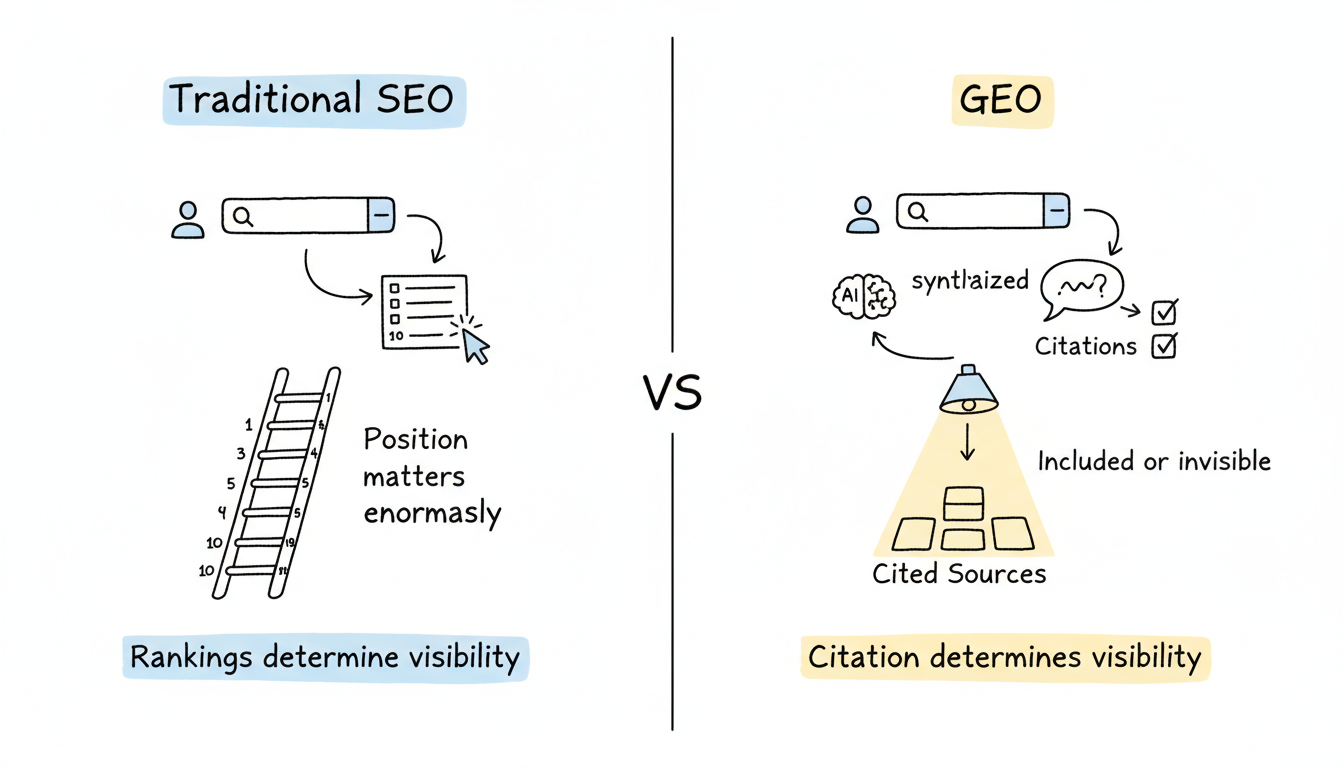
Unlike traditional search engines that return lists of links for users to explore, generative engines provide single summarized answers. There's no page one with ten results—there's one comprehensive response that either includes your brand or doesn't.
Understanding the fundamental differences helps you optimize effectively for both channels, much like how understanding the distinction between GEO and SEO requires a combined strategy that addresses both traditional and AI-powered search.
Traditional SEO: Users type queries → Search engines return ranked results → Users click through to websites
GEO: Users ask questions → AI synthesizes answers from multiple sources → Users may never see original sources
In traditional search, ranking determines visibility. In AI search, citation determines visibility. A page can rank #15 on Google yet be prominently cited by ChatGPT—or rank #1 and never appear in AI responses.
SEO optimizes for rankings: Getting your pages to appear higher in search results lists. Position matters enormously—top three organic results capture over 50% of clicks.
GEO optimizes for citations: Getting your content quoted, referenced, or attributed in AI-generated answers. There's no "position 7" in an AI response—you're either included or invisible. Understanding how Google selects AI Overview sources helps you optimize for these citation opportunities.
SEO success metrics:
GEO success metrics:
Tools like an AEO checker can help you monitor your performance across these AI-powered platforms and track citation frequency.
What SEO-optimized content looks like:
What GEO-optimized content looks like:
The search landscape has fundamentally shifted. AI platforms now process billions of queries daily. ChatGPT handles over 2.5 billion prompts per day. Industry analysts expect AI-driven search traffic to surpass traditional search by 2028.
The visibility problem: 36.4% of content marketers reported traffic drops between 2024 and 2025 due to AI Overviews and AI search. Understanding AI Overview traffic impact by industry reveals which sectors face the most significant challenges. Your content might be excellent, but if it's not appearing in AI results, it's reaching a smaller audience than it should.
The opportunity: Brands optimizing for GEO now are establishing presence in AI systems before the space becomes saturated. Early movers build authority advantages that compound over time.
The business impact: When founders research solutions in ChatGPT or buyers compare options in Perplexity, they're forming opinions before ever reaching your website. If you're not cited when prospects ask "best marketing automation for mid-market SaaS" or "how to evaluate PR agencies," you're not in the consideration set.
AI platforms don't rank documents the way traditional search engines do. They evaluate content for citation worthiness based on different signals, similar to how SearchGPT ranking factors determine which sources appear in AI-generated responses.
AI systems cross-reference your brand identity across multiple sources. They look for:
Building entity-based SEO and topical authority signals helps AI systems recognize and trust your content as a credible source.
AI systems favor content they can easily parse and quote. This means:
Implementing question-based headers for AEO makes your content more extractable for AI platforms that prioritize direct, quotable answers.
Generative engines evaluate whether your content is:
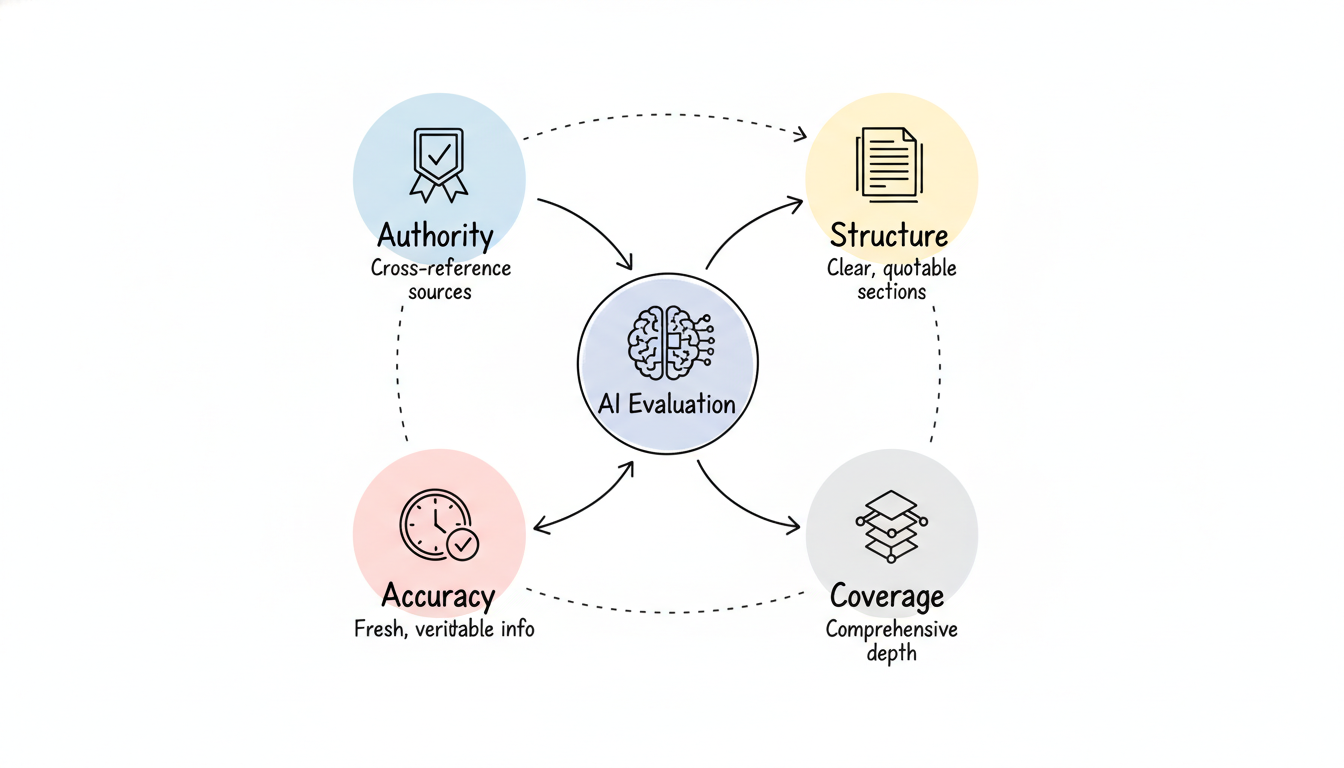
AI platforms prefer sources that demonstrate comprehensive expertise:
You don't need to abandon SEO for GEO—they work together. Strong SEO fundamentals directly improve AI visibility. Content ranking well in traditional search has higher probability of AI citation.
Audit your current AI visibility: Test 10-20 questions your buyers actually ask in ChatGPT, Perplexity, and Google AI Overviews. Who gets cited? Is it you, competitors, or nobody in your space? Following Google AI Overview optimization tips can help improve your citation frequency across these platforms.
Start with existing content: Your top-ranking pages already have SEO advantage. Add schema markup, restructure with front-loaded answers, cite primary sources. Quick wins come from optimizing what's already working.
Implement structured data: Organization, Person, Article, and FAQ schemas help AI systems understand and parse your content more accurately. Proper Google Knowledge Graph optimization ensures your entity information appears consistently across AI platforms.
Answer-first formatting: Place direct answers immediately after headers, written to stand alone if excerpted. AI systems extract these answers more reliably than content buried in paragraphs.
AI-friendly structures include:
Understanding AI Overview vs featured snippets helps you structure content that performs well in both traditional and AI-powered search results.
Beyond content optimization, GEO requires building signals AI systems recognize:
Demonstrating E-E-A-T for Answer Engine Optimization strengthens your authority signals across all AI platforms.
GEO priority varies by how your customers discover and evaluate options.
B2B companies: Probably essential. Buyers research solutions in ChatGPT and Perplexity before talking to sales. If you're not cited in relevant AI responses, you're not in consideration sets.
E-commerce: Growing importance. Product research is shifting to AI platforms, especially for considered purchases. Being cited matters when someone asks "best ergonomic office chair under $500."
Local service businesses: Maybe not yet. If customers find you through Google Maps, local directories, and referrals, focus on local SEO first. AI visibility becomes important as local search behavior evolves.
Publishers and media: Highly relevant. Your content is what AI systems cite. Structured, authoritative content increases citation frequency across platforms. Learning from knowledge panel success stories shows how media brands build consistent entity presence.
No—GEO extends SEO. Strong SEO fundamentals improve AI visibility. Brands abandoning traditional SEO for GEO-only strategies lose billions of search queries. Both channels have unique value.
AI systems read meaning, not keyword matches. They evaluate expertise, authority, and trustworthiness across your entire digital presence—not just on-page keyword usage.
Google's AI Overviews integrate GEO and SEO signals. The distinction between "traditional search" and "AI search" is blurring. Optimization for both increasingly overlaps.
GEO stands for Generative Engine Optimization. It's the practice of optimizing content so AI-powered search engines like ChatGPT, Perplexity, and Google AI Overviews can find, interpret, and cite it when generating responses to user queries.
SEO remains valuable, but GEO addresses where search is heading. AI platforms capture growing query volume. Integrating GEO with existing SEO strategies captures visibility across both traditional and AI-powered search.
GEO improvements can appear within days as AI platforms discover and cite optimized content. This is faster than traditional SEO, where ranking improvements typically take weeks to months. However, building sustained AI authority compounds over time.
Start with platforms your audience uses most. ChatGPT has the largest user base, but Perplexity matters more for research-oriented audiences. Google AI Overviews affect the most total searches. Monitor where your buyers actually discover information. Tracking SearchGPT citation tracking and measuring visibility helps you understand which platforms drive the most value for your brand.
By submitting this form, you agree to our Privacy Policy and Terms & Conditions.



